
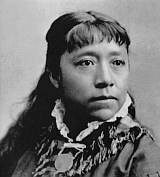
Sarah Winnemucca
Sarah Winnemucca was a Native American writer, activist, scout, and teacher. Born 1844, in Humboldt Sink. Died October 17, 1891, in Idaho. Known for Life Among the Piutes: Their Wrongs and Claims. Awards include National Women's Hall of Fame and member of the Nevada Writers Hall of Fame.
Facts
12 facts · 2 confirmed by two sources · 4 cited · 6 from one source
Where this comes from
Papalocal keeps its own record. It started from these sources; what each one said is kept here as it was copied, so a change on their side never changes this page by itself. Tap one to read its version.
What Wikidata says · copied November 16, 2026 · revision 2570027728
- Described as
- Native American writer, activist, scout, and teacher (1844–1891)
- Other names
- Sarah Winnemucca Hopkins, Thocmetony, Sarah Winnemucca (Hopkins), Sarah Winnemucca Bartlett Hopkins
- Born
- 1844 · 4 references
- Died
- October 17, 1891 · 2 references
- Born in
- Humboldt Sink
- Died in
- Idaho
- Cause of death
- tuberculosis
- Citizen of
- United States · 1 reference
- Occupation
- writer · 2 references; teacher
- Known for
- Life Among the Piutes: Their Wrongs and Claims
- Awards
- National Women's Hall of Fame (1994) · 1 reference; member of the Nevada Writers Hall of Fame (1993) · 1 reference
- Father
- Winnemucca
- Wikipedias with a page
- 23
Wikidata item Q438194 (wikidata.org/wiki/Q438194), public domain (CC0). Copied November 16, 2026.
What Wikipedia says · copied November 16, 2026 · revision 1380398473
Sarah Hopkins (née Winnemucca; c. 1844 – October 17, 1891) was a Northern Paiute writer, activist, lecturer, teacher, and school organizer. Her Northern Paiute name was Thocmentony, also spelled Tocmetone, which translates as "Shell Flower".
Sarah Winnemucca was born near Humboldt Lake, in present-day Nevada, into an influential Northern Paiute family who led their community in pursuing friendly relations with the arriving groups of Anglo-American settlers. She was the daughter of Chief Winnemucca of the Paiute nation and the granddaughter of Chief Truckee. At 16, Sarah studied at a Catholic school in San Jose, California. When the Paiute War erupted between the Pyramid Lake Paiute and the settlers, including some who were friends of the Winnemucca family, Sarah and some of her family traveled to San Francisco and Virginia City to escape the fighting. They made a living performing onstage as "A Paiute Royal Family". In 1865, while the Winnemucca family was away, their band was attacked by the U.S. cavalry, who killed 29 Paiutes, including Sarah's mother and several members of her extended family.
At the age of 27, Sarah began working in the Bureau of Indian Affairs at Fort McDermit in 1871 as an interpreter. Subsequently, Winnemucca became an advocate for the rights of Native Americans, traveling across the U.S. to tell Anglo- Americans about the plight of her people. When the Paiute were interned in a concentration camp at Yakima, Washington after the Bannock War, she traveled to Washington, D.C., to lobby Congress and the executive branch for their release. She also served U.S. forces as a messenger, interpreter, and guide, and as a teacher for imprisoned Native Americans.
Winnemucca published Life Among the Piutes: Their Wrongs and Claims (1883), which is both a memoir and a history of her people during their first 40 years of contact with European Americans. It is considered the "first known autobiography written by a Native American woman". Anthropologist Omer Stewart described it as "one of the first and one of the most enduring ethnohistorical books written by an American Indian", frequently cited by scholars. Following the publication of the book, Winnemucca toured the Eastern United States, giving lectures about her people in New England, Pennsylvania, and Washington, D.C. She returned to the West, founding a private school for Native American children in Lovelock, Nevada.
Since the late 20th century, scholars have paid renewed attention to Winnemucca for her accomplishments. In 1993, she was inducted posthumously into the Nevada Writers Hall of Fame. In 2005, the state of Nevada contributed a statue of her by sculptor Benjamin Victor to the National Statuary Hall Collection in the U.S. Capitol.
Winnemucca's legacy has been controversial. She was praised for her activism and social work to better living conditions for her people. However, she was criticized for a tendency to exaggerate her social status among the Paiute when speaking to outsiders. Among the Paiute, her assistance to the U.S. military at a time when they were at war with the Paiute was divisive, as was her advocacy for assimilation of Natives to Anglo-American culture.
- Born, in its opening lines
- c. 1844
- Died, in its opening lines
- October 17, 1891
From the Wikipedia article “Sarah Winnemucca” (en.wikipedia.org/wiki/Sarah_Winnemucca), by its contributors, under CC BY-SA 4.0 (creativecommons.org/licenses/by-sa/4.0/). Copied November 16, 2026; not changed.
Confirmed Two sources agree. Cited One source, and it names where it got it. One source One source, without a reference of its own. Sources disagree The sources disagree. We show the best-supported value and keep theirs below.
