
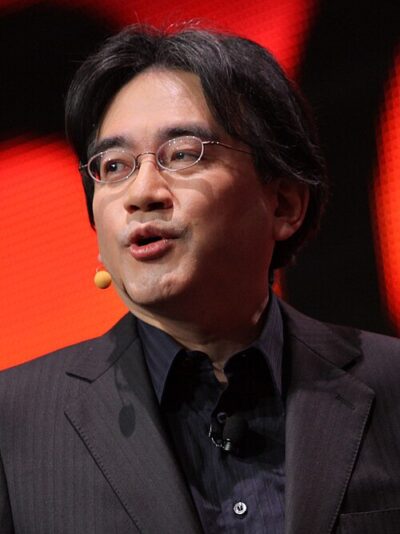
Satoru Iwata
Satoru Iwata was a Japanese video game programmer and businessman. Born December 6, 1959, in Sapporo. Died July 11, 2015, in Kyoto. Positions held include chairperson (2 times) (1993–2015). Known for Ask Iwata: Words of Wisdom from Nintendo's Legendary CEO. Educated at Tokyo Institute of Technology and Hokkaido Sapporo Minami High School.
Facts
20 facts · 2 confirmed by two sources · 6 cited · 12 from one source
Where this comes from
Papalocal keeps its own record. It started from these sources; what each one said is kept here as it was copied, so a change on their side never changes this page by itself. Tap one to read its version.
What Wikidata says · copied November 16, 2026 · revision 2568828735
- Described as
- Japanese video game programmer and businessman (1959–2015)
- Other names
- Iwata Satoru, Iwata
- Born
- December 6, 1959 · 1 reference
- Died
- July 11, 2015 · 1 reference
- Born in
- Sapporo · 1 reference
- Died in
- Kyoto · 1 reference
- Cause of death
- cholangiocarcinoma
- Citizen of
- Japan
- Occupation
- entrepreneur · 1 reference; game programmer · 1 reference; video game producer; engineer; computer scientist; executive producer · 1 reference; programmer · 1 reference
- Positions held
- chairperson (2 times) (1993–2015)
- Worked for
- Nintendo; HAL Laboratory
- Education
- Tokyo Institute of Technology; Hokkaido Sapporo Minami High School
- Known for
- Ask Iwata: Words of Wisdom from Nintendo's Legendary CEO
- Father
- Hiroshi Iwata
- Wikipedias with a page
- 51
Wikidata item Q316013 (wikidata.org/wiki/Q316013), public domain (CC0). Copied November 16, 2026.
What Wikipedia says · copied November 16, 2026 · revision 1385010422
Satoru Iwata (Japanese: 岩田 聡; December 6, 1959 – July 11, 2015) was a Japanese businessman, video game programmer and producer. Beginning in 2002, Iwata served as the fourth president of Nintendo, as well as the chief executive officer (CEO) of Nintendo of America from 2013 until his death in 2015. Iwata was a major contributor in broadening the appeal of video games by focusing on novel and entertaining games rather than top-of-the-line hardware. Iwata was the first president of Nintendo to be unrelated to the founder, Fusajiro Yamauchi.
Born in Sapporo, Iwata expressed interest in video games from an early age and created his first simple game while in high school. He majored in computer science at the Tokyo Institute of Technology. In 1980, he joined the game developer HAL Laboratory while attending the university. At HAL, he worked as a programmer and closely collaborated with Nintendo, producing his first commercial game in 1983. Games to which he contributed include EarthBound and many games in the Kirby series. Following a downturn and near-bankruptcy, Iwata became the president of HAL in 1993 at the insistence of Nintendo president Hiroshi Yamauchi and brought financial stability. In the following years, he worked in the development of the Pokémon and Super Smash Bros. series. Iwata joined Nintendo as the head of its corporate planning division in 2000.
Nintendo saw growth under Iwata and, when Yamauchi retired, he was sworn in as the company's president in May 2002. Under Iwata's leadership, Nintendo developed the Nintendo DS and Wii game consoles, helping the company achieve massive financial success. As a self-declared gamer, he focused on expanding the appeal of video games across demographics through a "blue ocean" business strategy. Nintendo attained record profits by 2009, and Barron's placed Iwata among the top 30 CEOs worldwide. Iwata expanded his strategy by defining a quality-of-life product line for the Wii that evolved into a ten-year strategy to create standalone products. Later hardware such as the Nintendo 3DS and Wii U proved far less profitable than the Wii, and Nintendo's net sales fell by two thirds from 2009 to 2012; the company saw its first operating losses in 30 years during this time. Iwata voluntarily halved his salary in 2011 and again in 2014. In 2015, after several years of decline, Iwata put a portion of Nintendo's focus into the rapidly growing mobile game market; a landmark partnership with mobile provider DeNA was established that March. Throughout his career, Iwata built a relationship with Nintendo fans through social media and his regular appearances in Iwata Asks and Nintendo Direct, becoming the public face of the company.
In June 2014, a tumor in Iwata's bile duct was discovered during a routine physical exam. It was removed, and Iwata returned to work in October of that year. The problem resurfaced in 2015, and Iwata died at the age of 55 from its complications on July 11. Members of the gaming industry and gamers worldwide alike offered tributes through public announcements and social media, and fans worldwide established temporary memorials. Iwata was posthumously awarded the Lifetime Achievement Award at the 2015 Golden Joystick Awards and the 2016 D.I.C.E. Awards.
- Born, in its opening lines
- December 6, 1959
- Died, in its opening lines
- July 11, 2015
From the Wikipedia article “Satoru Iwata” (en.wikipedia.org/wiki/Satoru_Iwata), by its contributors, under CC BY-SA 4.0 (creativecommons.org/licenses/by-sa/4.0/). Copied November 16, 2026; not changed.
Confirmed Two sources agree. Cited One source, and it names where it got it. One source One source, without a reference of its own. Sources disagree The sources disagree. We show the best-supported value and keep theirs below.
