
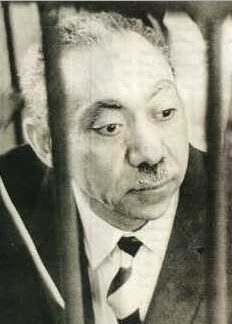
Sayyid Qutb
Sayyid Qutb was an Egyptian political theorist and revolutionary. Born October 9, 1906, in Musha. Died August 29, 1966, in Cairo. Known for Milestones, Fi Zilal al-Quran and The Future of This Religion. Educated at Cairo University and University of Northern Colorado.
Facts
31 facts · 2 confirmed by two sources · 6 cited · 23 from one source
What’s different
- Died: we show August 29, 1966 (Confirmed). Wikidata also lists 1967
Where this comes from
Papalocal keeps its own record. It started from these sources; what each one said is kept here as it was copied, so a change on their side never changes this page by itself. Tap one to read its version.
What Wikidata says · copied November 16, 2026 · revision 2568215169
- Described as
- Egyptian political theorist and revolutionary (1906–1966)
- Born
- October 9, 1906 · 2 references
- Died
- August 29, 1966 · 3 references; 1967 · 1 reference
- Born in
- Musha · 1 reference
- Died in
- Cairo · 1 reference
- Cause of death
- hanging to death · 1 reference
- Name at birth
- سَيِّد قُطْب إِبْرَاهِيم حُسَيْن الشَّاذِلِيّ
- Citizen of
- Egypt; Ottoman Empire (1906–1914) · 1 reference
- Occupation
- politician; writer · 1 reference; philosopher; journalist · 2 references; poet; non-fiction writer · 1 reference; revolutionary · 1 reference; academic · 1 reference
- Political party
- Wafd Party
- Education
- Cairo University; University of Northern Colorado
- Member of
- Muslim Brotherhood in Egypt · 1 reference
- Known for
- Milestones · 1 reference; Fi Zilal al-Quran · 1 reference; The Future of This Religion; The Characteristics and Values of Islamic Conduct; Artistic Imagery in the Qur'an; Scenes of Resurrection in the Qur’an; ʾAkhī
- Siblings
- Muhammad Qutb · 1 reference; Hamida Qutb; Amineh Qutb
- Religion
- Islam
- Wikipedias with a page
- 65
Wikidata item Q211379 (wikidata.org/wiki/Q211379), public domain (CC0). Copied November 16, 2026.
What Wikipedia says · copied November 16, 2026 · revision 1383018545
Sayyid Ibrahim Husayn Shadhili Qutb (9 October 1906 – 29 August 1966) was an Egyptian political theorist and revolutionary who was a leading member of the Muslim Brotherhood.
As the author of 24 published books, with around 30 unpublished for different reasons (mainly due to destruction by the state), and at least 581 articles, including novels, literary arts critique and works on education, Qutb is best known in the Muslim world for his work on what he believed to be the social and political role of Islam, particularly in his books Social Justice and Ma'alim fi al-Tariq (Milestones). His magnum opus, Fi Zilal al-Qur'an (In the Shade of the Qur'an), is a 30-volume commentary on the Quran. Even though most of his observations and criticism were leveled at the Muslim world, Qutb also intensely disapproved of the society and culture of the United States, which he saw as materialistic, and obsessed with violence and sexual pleasures. He advocated offensive jihad.
During most of his life, Qutb's inner circle mainly consisted of influential politicians, intellectuals, poets and literary figures, both of his age and of the preceding generation. By the mid-1940s, many of his writings were included in the curricula of schools, colleges and universities. In 1966, he was convicted of plotting the assassination of Egyptian President Gamal Abdel Nasser and was executed by hanging.
Qutb has been described by followers as a great thinker and martyr for Islam, while Western observers and some Muslims see him as a key originator of Islamist ideology, and an inspiration for militant Islamist groups, such as al-Qaeda. Strengthened by his status as a martyr, Qutb's ideas on Jahiliyya (Age of Ignorance) and his close linking of implementation of sharia (Islamic Law) with Tawhid (Islamic monotheism) has highly influenced contemporary Islamist and Jihadist movements. His supporters are often identified as Qutbists or Qutbi.
- Born, in its opening lines
- October 9, 1906
- Died, in its opening lines
- August 29, 1966
From the Wikipedia article “Sayyid Qutb” (en.wikipedia.org/wiki/Sayyid_Qutb), by its contributors, under CC BY-SA 4.0 (creativecommons.org/licenses/by-sa/4.0/). Copied November 16, 2026; not changed.
Confirmed Two sources agree. Cited One source, and it names where it got it. One source One source, without a reference of its own. Sources disagree The sources disagree. We show the best-supported value and keep theirs below.
