
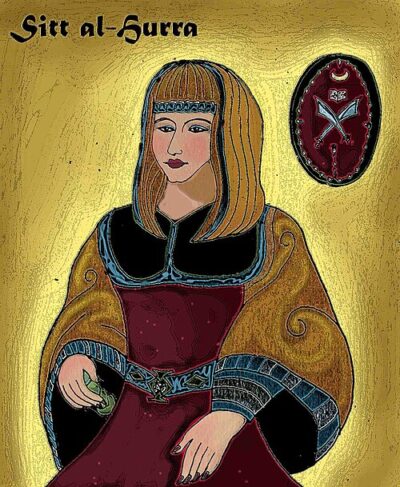
Sayyida al-Hurra
Sayyida al-Hurra was the 16th-century Moroccan ruler of Tétouan and privateer. Born 1485, in Chefchaouen. Died 1561, in Chefchaouen. Positions held include governor (1515–1542) and Tétouan.
Facts
12 facts · 0 confirmed by two sources · 0 cited · 12 from one source
Where this comes from
Papalocal keeps its own record. It started from these sources; what each one said is kept here as it was copied, so a change on their side never changes this page by itself. Tap one to read its version.
What Wikidata says · copied November 16, 2026 · revision 2565825554
- Described as
- 16th-century Moroccan ruler of Tétouan and privateer
- Born
- 1485
- Died
- 1561
- Born in
- Chefchaouen
- Died in
- Chefchaouen
- Citizen of
- Morocco
- Occupation
- politician; sultana (1541–1549); privateer
- Positions held
- governor (1515–1542); Tétouan
- Spouse
- Abu al-Abbas Ahmad ibn Muhammad
- Father
- Ali ibn Rashid al-Alami
- Wikipedias with a page
- 32
Wikidata item Q4299447 (wikidata.org/wiki/Q4299447), public domain (CC0). Copied November 16, 2026.
What Wikipedia says · copied November 16, 2026 · revision 1379579766
Lalla ʿĀʾisha bint ʿAlī ibn Rāshid al-ʿAlamī (Arabic: عائشة بنت علي بن رشيد العلمي), commonly known as Sayyida al-Ḥurra (السيدة الحرة, transl. The Lady, the Free lady), was a Moroccan privateer who governed the city of Tétouan from 1515 to 1542. As the wife of Moroccan king Abu al-Abbas Ahmad ibn Muhammad, who was her second husband, she belonged to the Wattasid dynasty. She is considered to be "one of the most important female figures of the Islamic West in the modern age."
Her exact date of birth is unknown, but various sources estimate her to be born somewhere between 1491-1495. Likewise, there is a lot of discussion surrounding her death; some say she died in 1552, while others place her death a decade later (1561, 1562).
The era of her life and career was largely marked by a widespread struggle between the Christian world and the Muslim world: the Ottoman Empire had conquered Constantinople in 1453, ending the Eastern Byzantine Empire; the Portuguese Empire had begun conquering ports along the western Moroccan coast around 1487; and the Reconquista had returned the Iberian Peninsula to European Christian rule by 1492, eventually leading to the expulsion or forced conversion of Muslims in Spain.
Al-Hurra split control over the Mediterranean Sea with her ally Hayreddin Barbarossa, an Ottoman corsair who operated in the east while she operated in the west. In 1515, she became the last person in Muslim history to legitimately hold the title "al-Hurra" following the death of her first husband Sidi al-Mandri II, who ruled Tétouan. Her marriage to her second husband marks the only time in Moroccan history that a king married away from the capital city Fez, as al-Hurra refused to leave Tétouan.
From the Wikipedia article “Sayyida al Hurra” (en.wikipedia.org/wiki/Sayyida_al_Hurra), by its contributors, under CC BY-SA 4.0 (creativecommons.org/licenses/by-sa/4.0/). Copied November 16, 2026; not changed.
Confirmed Two sources agree. Cited One source, and it names where it got it. One source One source, without a reference of its own. Sources disagree The sources disagree. We show the best-supported value and keep theirs below.
