
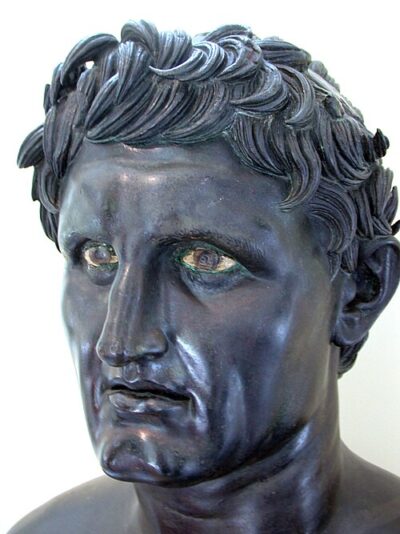
Seleucus I Nicator
Seleucus I Nicator was a general of Alexander and founder of the Seleucid dynasty. Born 358 BC, in Europos. Died 281 BC, in Lysimachia. Positions held include Seleucid ruler (-312–-281).
Facts
20 facts · 0 confirmed by two sources · 2 cited · 18 from one source
Where this comes from
Papalocal keeps its own record. It started from these sources; what each one said is kept here as it was copied, so a change on their side never changes this page by itself. Tap one to read its version.
What Wikidata says · copied November 16, 2026 · revision 2561374230
- Described as
- general of Alexander and founder of the Seleucid dynasty
- Other names
- Seleucus Nicator, Seleucus I
- Born
- 358 BC
- Died
- 281 BC · 1 reference
- Born in
- Europos
- Died in
- Lysimachia
- Buried in
- Seleucia Pieria
- Citizen of
- Macedonia; Seleucid Empire
- Occupation
- sovereign
- Positions held
- Seleucid ruler (-312–-281)
- Spouse
- Apama; Stratonice of Syria · 1 reference
- Children
- Antiochus I Soter · 1 reference; Phila · 1 reference; Achaeus · 1 reference; Apama; Berenice
- Father
- Antiochus
- Mother
- Laodice of Macedonia
- Siblings
- Didymeia
- Religion
- Ancient Greek religion
- Wikipedias with a page
- 74
Wikidata item Q184176 (wikidata.org/wiki/Q184176), public domain (CC0). Copied November 16, 2026.
What Wikipedia says · copied November 16, 2026 · revision 1381235944
Seleucus I Nicator (; Greek: Σέλευκος Νικάτωρ, Séleukos Nikátōr, "Seleucus the Victorious"; c. 358 BC – 281 BC) was a Macedonian Greek general, officer and successor of Alexander the Great who founded the eponymous Seleucid Empire of the Seleucid Dynasty. Initially a secondary player in the power struggles following Alexander's death, Seleucus rose to become the total ruler of Asia Minor, Syria, Mesopotamia, and the Iranian plateau, assuming the title of basileus (king). The Seleucid Empire was one of the major powers of the Hellenistic world, until it was overcome by the Roman Republic and Parthian Empire in the late second and early first centuries BC.
While serving under Alexander, Seleucus was commander of the Hypaspistai, an elite Macedonian infantry unit. After the death of Alexander in June 323 BC, Seleucus initially supported Perdiccas, the regent of Alexander's empire, and was appointed Commander of the Companions and chiliarch at the Partition of Babylon in 323 BC. However, after the outbreak of the Wars of the Diadochi in 322, Perdiccas' military failures against Ptolemy in Egypt led to the mutiny of his troops in Pelusium. Perdiccas was betrayed and assassinated in a conspiracy by Seleucus, Peithon and Antigenes in Pelusium sometime in either 321 or 320 BC. At the Partition of Triparadisus in 321 BC, Seleucus was appointed Satrap of Babylon under the new regent Antipater. But almost immediately, the wars between the Diadochi resumed and one of the most powerful of the Diadochi, Antigonus, forced Seleucus to flee Babylon. Seleucus was only able to return to Babylon in 312 BC with the support of Ptolemy. From 312 BC, Seleucus ruthlessly expanded his dominions and eventually conquered the Persian and Median lands. Seleucus ruled not only Babylonia, but the entire eastern part of Alexander's empire.
Seleucus further made claim to the former satrapies in Gandhara and in northwest India. However these ambitions were contested by Chandragupta Maurya, resulting in the Seleucid–Mauryan War (305–303 BC). The conflict was ultimately resolved by a treaty resulting in the Maurya Empire annexing the eastern satrapies. Additionally, a marriage alliance was formed, with Chandragupta marrying a daughter of Seleucus, according to Strabo and Appian. Furthermore, the Seleucid Empire received a considerable military force of 500 war elephants with mahouts, which would play a decisive role against Antigonus at the Battle of Ipsus in 301 BC. In 281 BC, Seleucus also defeated Lysimachus at the Battle of Corupedium, adding Asia Minor to his empire.
Seleucus' victories against Antigonus and Lysimachus left the Seleucid dynasty virtually unopposed amongst the Diadochi. However, Seleucus also hoped to take control of Lysimachus' European territories, primarily Thrace and Macedon itself. But upon arriving in Thrace in 281 BC, Seleucus was assassinated by Ptolemy Ceraunus, who had taken refuge at the Seleucid court with his sister Lysandra. The assassination of Seleucus destroyed Seleucid prospects in Thrace and Macedon, and paved the way for Ptolemy Ceraunus to absorb much of Lysimachus' former power in Macedon. Seleucus was succeeded by his son Antiochus I as ruler of the Seleucid Empire. Seleucus founded a number of new cities during his reign, including Antioch (300 BC), Edessa and Seleucia on the Tigris (c. 305 BC), a foundation that eventually depopulated Babylon.
From the Wikipedia article “Seleucus I Nicator” (en.wikipedia.org/wiki/Seleucus_I_Nicator), by its contributors, under CC BY-SA 4.0 (creativecommons.org/licenses/by-sa/4.0/). Copied November 16, 2026; not changed.
Confirmed Two sources agree. Cited One source, and it names where it got it. One source One source, without a reference of its own. Sources disagree The sources disagree. We show the best-supported value and keep theirs below.
