
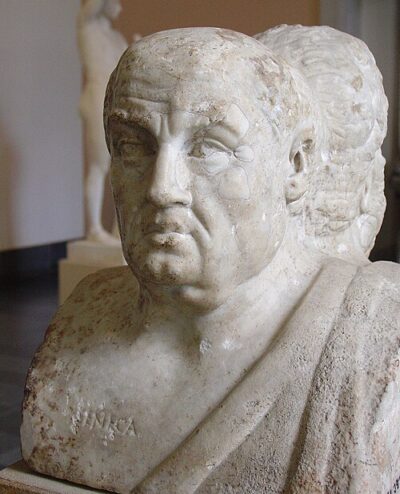
Seneca
Seneca was a Roman Stoic philosopher, statesman and dramatist (c. 4 BCE–65 CE). Born 0s BC, in Corduba. Died April 12, 65, in Rome. Positions held include ancient Roman senator. Known for De Vita Beata, Epistulae morales ad Lucilium and De ira.
Facts
31 facts · 0 confirmed by two sources · 8 cited · 23 from one source
Where this comes from
Papalocal keeps its own record. It started from these sources; what each one said is kept here as it was copied, so a change on their side never changes this page by itself. Tap one to read its version.
What Wikidata says · copied November 16, 2026 · revision 2568741912
- Described as
- Roman Stoic philosopher, statesman and dramatist (c. 4 BCE–65 CE)
- Other names
- Lucius Annaeus Seneca the Younger, Lucius Annaeus Seneca, L. Annæus Seneca, Lucius Annaeus Seneca Iunior, Seneca the Younger, the Younger Seneca, Annaeus Seneca, Lucius Annaeus Seneca minor, Lucio Anneo Seneca
- Born
- 0s BC
- Died
- April 12, 65
- Born in
- Corduba · 1 reference
- Died in
- Rome · 1 reference
- Cause of death
- exsanguination
- Citizen of
- Ancient Rome
- Occupation
- playwright · 1 reference; poet; philosopher · 3 references; aphorist; statesperson; politician · 1 reference; writer · 2 references; naturalist · 1 reference
- Positions held
- ancient Roman senator
- Known for
- De Vita Beata; Epistulae morales ad Lucilium; De ira; De Brevitate Vitae; Medea
- Field
- ethics; political philosophy; philosophy · 1 reference; drama · 1 reference
- Spouse
- Pompeia Paulina
- Father
- Seneca the Elder · 1 reference
- Mother
- Helvia
- Siblings
- Lucius Junius Gallio Annaeanus; Marcus Annaeus Mela · 1 reference
- Lived in
- Corsica; Rome
- Wikipedias with a page
- 159
Wikidata item Q2054 (wikidata.org/wiki/Q2054), public domain (CC0). Copied November 16, 2026.
What Wikipedia says · copied November 16, 2026 · revision 1385568559
Lucius Annaeus Seneca the Younger ( SEN-ik-ə; c. 4 BC – AD 65), usually known mononymously as Seneca, was a Stoic philosopher of Ancient Rome, a statesman, a dramatist, and in one work (Apocolocyntosis) a satirist from the post-Augustan age of Latin literature.
Seneca was born in Colonia Patricia Corduba in Hispania, and was trained in rhetoric and philosophy in Greece. His father was Seneca the Elder, his elder brother was Lucius Junius Gallio Annaeanus, and his nephew was the poet Lucan. In AD 41, Seneca was exiled to the island of Corsica under emperor Claudius, but was allowed to return in 49 to become a tutor to Nero. When Nero became emperor in 54, Seneca became his advisor and, together with the praetorian prefect Sextus Afranius Burrus, provided competent government for the first five years of Nero's reign. Seneca's influence over Nero declined with time, and in 65 Seneca was executed by forced suicide for alleged complicity in the Pisonian conspiracy to assassinate Nero, of which he may have been innocent, although there is still no consensus agreement. His stoic and calm suicide has become the subject of numerous paintings.
As a writer, Seneca is known for his philosophical works, and for his plays, which are all tragedies. His prose works include 12 essays and 124 letters dealing with moral issues. These writings constitute one of the most important bodies of primary material for ancient Stoicism. As a tragedian, he is best known for plays such as his Medea, Thyestes, and Phaedra. Seneca had an immense influence on later generations—during the Renaissance he was viewed as, in the words of E. F. Watling, "an oracle of moral, even of Christian, edification; a master of literary style and a model [for] dramatic art".
From the Wikipedia article “Seneca the Younger” (en.wikipedia.org/wiki/Seneca_the_Younger), by its contributors, under CC BY-SA 4.0 (creativecommons.org/licenses/by-sa/4.0/). Copied November 16, 2026; not changed.
Confirmed Two sources agree. Cited One source, and it names where it got it. One source One source, without a reference of its own. Sources disagree The sources disagree. We show the best-supported value and keep theirs below.
