
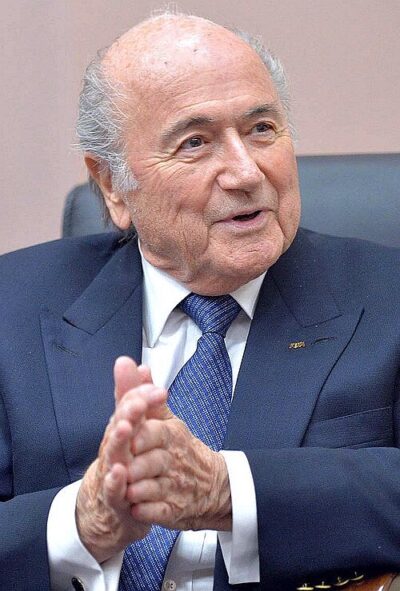
Sepp Blatter
Sepp Blatter is the 8th President of the International Federation of Association Football. Born March 10, 1936, in Visp. Positions held include president of FIFA (1998–2015) and Secretary General of FIFA (1981–1998). Educated at University of Lausanne and HEC Lausanne. Awards include Knight of the Legion of Honour, Commander's Cross of the Order of Merit of the Federal Republic of Germany and Order of Francisco de Miranda.







Facts
31 facts · 1 confirmed by two sources · 10 cited · 20 from one source
Where this comes from
Papalocal keeps its own record. It started from these sources; what each one said is kept here as it was copied, so a change on their side never changes this page by itself. Tap one to read its version.
What Wikidata says · copied November 16, 2026 · revision 2562963172
- Described as
- 8th President of the International Federation of Association Football
- Other names
- Josef Blatter, Joseph "Sepp" Blatter, Joseph S. Blatter, Joseph Blatter, Joseph Sepp Blatter
- Born
- March 10, 1936 · 5 references
- Born in
- Visp · 3 references
- Citizen of
- Switzerland · 1 reference
- Occupation
- sports official; economist; politician; ice hockey player · 1 reference; athlete · 1 reference
- Positions held
- president of FIFA (1998–2015) · 1 reference; Secretary General of FIFA (1981–1998)
- Education
- University of Lausanne (–1959); HEC Lausanne (–1958)
- Member of
- International Olympic Committee
- Sport
- association football; ice hockey · 1 reference
- Awards
- Knight of the Legion of Honour (2004) · 2 references; Commander's Cross of the Order of Merit of the Federal Republic of Germany (2006) · 1 reference; Order of Francisco de Miranda (2007) · 1 reference; Great Silver Medal of Honour for Services to the Republic of Austria (2008) · 1 reference; Order of Merit, 1st class (2001) · 1 reference; Order of Honour (2010) · 1 reference; Order of Friendship (2007) · 2 references; Order of the Companions of O. R. Tambo (2010) · 2 references; Order "Danaker" (2007) · 1 reference; Order of the Two Niles (2005) · 1 reference; Order of recognition (2005) · 1 reference; Order of the Republic (2001) · 2 references; Order of Zayed (2003) · 1 reference; National Order of Merit; Order of Prince Yaroslav the Wise, 2nd class (2013) · 1 reference
- Lived in
- Zurich
- Wikipedias with a page
- 92
Wikidata item Q483437 (wikidata.org/wiki/Q483437), public domain (CC0). Copied November 16, 2026.
What Wikipedia says · copied November 16, 2026 · revision 1380570126
Joseph Sepp Blatter (born Josef Blatter; 10 March 1936) is a Swiss former football administrator who served as the eighth president of FIFA from 1998 to 2015. He has been suspended from participating in FIFA activities since 2015 as a result of the FIFA corruption case made public that year, which remains in place until 2027.
From a background in business, public relations, and sports administration, Blatter became general secretary of FIFA in 1981 and was then elected president at the 51st FIFA Congress on 8 June 1998, succeeding João Havelange, who had headed the organization since 1974. Blatter was re-elected in 2002, 2007, 2011, and 2015. Like his predecessor Havelange, Blatter built his power base in FIFA by increasing the influence of numerous African and Asian countries in world football through the expansion of participating teams in various FIFA tournaments, culminating in the highly controversial awarding of the 2022 World Cup to Qatar. Although he has persistently been dogged by claims of corruption and financial mismanagement, Blatter's reign oversaw a vast expansion in revenues generated by the FIFA World Cup.
On 2 June 2015, six days after the United States government indicted several current and former FIFA officials and sports marketing companies for bribery and money laundering, Blatter announced that he would call for elections to choose a new president of FIFA and that he would not stand in these elections, but he also said he would remain in his position until an extraordinary FIFA Congress could be held for his successor to be elected. Criminal proceedings were announced against Blatter by the Swiss Attorney General's office on 25 September 2015, regarding "criminal mismanagement... and misappropriation".
In October 2015, Blatter and other top FIFA officials were suspended amid the investigation, and in December the independent FIFA Ethics Committee ejected Blatter from office and banned him from taking part in any FIFA activities over the following eight years. On 24 February 2016, a FIFA appeals committee upheld the suspension but reduced it from eight years to six. On 24 March 2021, he received a second ban for six years and was fined the amount of CHF 1,000,000 by the body's Ethics Committee after a probe into massive bonus payments. Issa Hayatou served as the acting President of FIFA until an extraordinary FIFA Congress was held in late February 2016, electing Gianni Infantino as the 9th president of FIFA.
- Born, in its opening lines
- March 10, 1936
From the Wikipedia article “Sepp Blatter” (en.wikipedia.org/wiki/Sepp_Blatter), by its contributors, under CC BY-SA 4.0 (creativecommons.org/licenses/by-sa/4.0/). Copied November 16, 2026; not changed.
Confirmed Two sources agree. Cited One source, and it names where it got it. One source One source, without a reference of its own. Sources disagree The sources disagree. We show the best-supported value and keep theirs below.
