
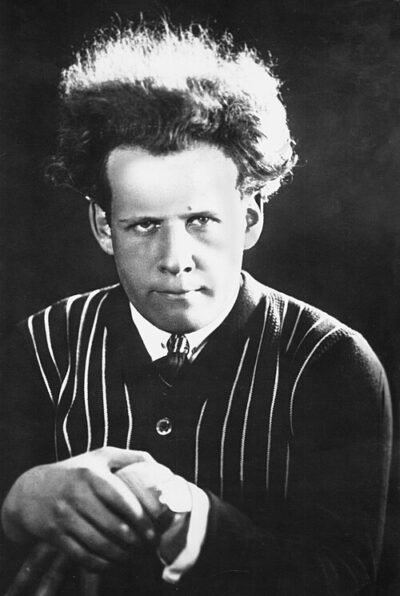
Sergei Eisenstein
Sergei Eisenstein was a Soviet filmmaker. Born January 10, 1898, in Riga. Died February 11, 1948, in Moscow. Known for October: Ten Days That Shook the World, Battleship Potemkin and The General Line. Educated at Saint-Petersburg State University of Architecture and Civil Engineering. Awards include Stalin Prize, Order of Lenin and Order of the Badge of Honour.
Facts
35 facts · 1 confirmed by two sources · 8 cited · 25 from one source · 1 where the sources disagree
What’s different
- Born: we show January 10, 1898 (Sources disagree). Wikipedia says January 22, 1898
Where this comes from
Papalocal keeps its own record. It started from these sources; what each one said is kept here as it was copied, so a change on their side never changes this page by itself. Tap one to read its version.
What Wikidata says · copied November 16, 2026 · revision 2567341036
- Described as
- Soviet filmmaker (1898–1948)
- Other names
- Sergei Mikhailovich Eisenstein, Sergei M. Eisenstein, Sergei Eizenshtein, Sergei Mikhailovich Eizenshtein, Sergej Michail Eisenstein, Sergeiĭ Mikhaiĭlovich Aiĭzenshtaiĭn, Sergeij Eisenstein, Sergej Michajlovic Ejzenstejn, Sergey Mikhaylovich Eisenstein, Sergej Eisenstein
- Born
- January 10, 1898 · 2 references
- Died
- February 11, 1948 · 11 references
- Born in
- Riga · 3 references
- Died in
- Moscow · 3 references
- Buried in
- Novodevichy Cemetery
- Cause of death
- myocardial infarction
- Name at birth
- Сергей Михайлович Эйзенштейн
- Citizen of
- Russian Empire; Soviet Union
- Occupation
- film director · 1 reference; inventor; film editor · 1 reference; screenwriter · 2 references; teacher; cinematographer · 1 reference; draftsperson · 2 references; photographer · 1 reference
- Worked for
- Gerasimov Institute of Cinematography
- Education
- Saint-Petersburg State University of Architecture and Civil Engineering (–1915)
- Genre
- French Impressionist Cinema · 1 reference; socialist realism
- Known for
- October: Ten Days That Shook the World; Battleship Potemkin; The General Line
- Awards
- Stalin Prize (1941); Order of Lenin (1939); Order of the Badge of Honour; Medal "For Valiant Labour in the Great Patriotic War 1941–1945"; Honored art worker of the Russian Soviet Federative Socialist Republic; Medal "In Commemoration of the 800th Anniversary of Moscow"; State Stalin Prize, 1st degree · 1 reference
- Spouse
- Pera Atasheva
- Father
- Mikhail Eisenstein · 1 reference
- Mother
- Yulia Eisenstein
- Religion
- atheism
- Wikipedias with a page
- 148
Wikidata item Q8003 (wikidata.org/wiki/Q8003), public domain (CC0). Copied November 16, 2026.
What Wikipedia says · copied November 16, 2026 · revision 1383573728
Sergei Mikhailovich Eisenstein (22 January [O.S. 10 January] 1898 – 11 February 1948) was a Soviet film director, screenwriter, film editor and film theorist. Considered one of the greatest filmmakers of all time, he was a pioneer in the theory and practice of montage. He is noted in particular for his silent films Strike (1925), Battleship Potemkin (1925) and October (1928), as well as the historical epics Alexander Nevsky (1938) and Ivan the Terrible (1945/1958). In its decennial poll, the magazine Sight and Sound named his Battleship Potemkin the 54th-greatest film of all time.
- Born, in its opening lines
- January 22, 1898
- Died, in its opening lines
- February 11, 1948
From the Wikipedia article “Sergei Eisenstein” (en.wikipedia.org/wiki/Sergei_Eisenstein), by its contributors, under CC BY-SA 4.0 (creativecommons.org/licenses/by-sa/4.0/). Copied November 16, 2026; not changed.
Confirmed Two sources agree. Cited One source, and it names where it got it. One source One source, without a reference of its own. Sources disagree The sources disagree. We show the best-supported value and keep theirs below.
