
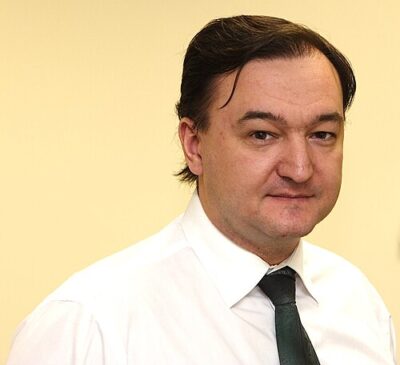
Sergei Magnitsky
Sergei Magnitsky was a Russian tax advisor who died in police custody. Born April 8, 1972, in Odesa. Died November 16, 2009, in Matrosskaya Tishina. Educated at Plekhanov Russian Economic University.
Facts
16 facts · 2 confirmed by two sources · 7 cited · 7 from one source
Where this comes from
Papalocal keeps its own record. It started from these sources; what each one said is kept here as it was copied, so a change on their side never changes this page by itself. Tap one to read its version.
What Wikidata says · copied November 16, 2026 · revision 2569800049
- Described as
- Russian tax advisor who died in police custody (1972–2009)
- Other names
- Sergey Leonidovich Magnitsky, Sergei Leonidovich Magnitsky
- Born
- April 8, 1972 · 1 reference
- Died
- November 16, 2009 · 1 reference
- Born in
- Odesa · 1 reference
- Died in
- Matrosskaya Tishina
- Buried in
- Preobrazhenskoye Cemetery
- Cause of death
- blunt trauma
- Citizen of
- Soviet Union (–1989); Russia
- Occupation
- lawyer; jurist · 2 references; auditor · 1 reference; statutory auditor · 1 reference; tax advisor · 1 reference
- Education
- Plekhanov Russian Economic University
- Field
- law · 1 reference; audit · 1 reference
- Wikipedias with a page
- 36
Wikidata item Q247917 (wikidata.org/wiki/Q247917), public domain (CC0). Copied November 16, 2026.
What Wikipedia says · copied November 16, 2026 · revision 1380364315
Sergei Leonidovich Magnitsky (Russian: Сергeй Леонидович Магнитский, pronounced [sʲɪrˈɡʲej lʲɪɐˈnʲidəvʲɪtɕ mɐɡˈnʲitskʲɪj]; Ukrainian: Сергій Леонідович Магнітський; 8 April 1972 – 16 November 2009) was a Russian tax advisor responsible for exposing corruption and misconduct by Russian government officials while representing client Hermitage Capital Management. His arrest in 2008 and subsequent death after eleven months in police custody generated international attention and triggered both official and unofficial inquiries into allegations of fraud, theft and human rights violations in Russia. His posthumous trial was the first in the Russian Federation.
Magnitsky alleged there had been large-scale theft from the Russian state, sanctioned and carried out by Russian officials. He was arrested and eventually died in prison seven days before the expiration of the one-year term during which he could be legally held without trial. In total, Magnitsky served 358 days in Moscow's Butyrka prison. He developed gall stones, pancreatitis, and a blocked gall bladder, and was denied medical care. A human rights council set up by the Kremlin found that he had been physically assaulted shortly before his death. His case became an international cause célèbre.
The United States Congress and President Barack Obama enacted the Magnitsky Act at the end of 2012, barring those Russian officials believed to be involved in Magnitsky's death from entering the United States or using its banking system. In response, Russia condemned the Act and claimed Magnitsky was guilty of crimes. Nearly a dozen other nations, as well as the European Union, have subsequently implemented or considered Magnitsky legislation.
In early January 2013, the Financial Times wrote that "the Magnitsky case is egregious, well documented and encapsulates the darker side of Putinism".
- Born, in its opening lines
- April 8, 1972
- Died, in its opening lines
- November 16, 2009
From the Wikipedia article “Sergei Magnitsky” (en.wikipedia.org/wiki/Sergei_Magnitsky), by its contributors, under CC BY-SA 4.0 (creativecommons.org/licenses/by-sa/4.0/). Copied November 16, 2026; not changed.
Confirmed Two sources agree. Cited One source, and it names where it got it. One source One source, without a reference of its own. Sources disagree The sources disagree. We show the best-supported value and keep theirs below.
