
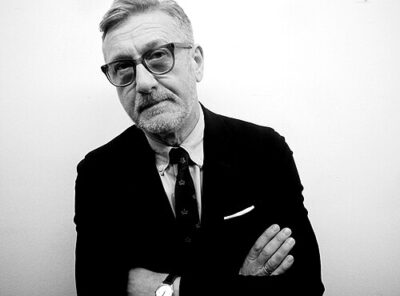
Sergei Sviatchenko
Sergei Sviatchenko is an Ukrainian artist. Born October 7, 1952, in Kharkiv. Educated at Kharkiv State Academy of Design and Fine Arts and National Academy of Visual Arts and Architecture.
Facts
15 facts · 0 confirmed by two sources · 6 cited · 9 from one source
Where this comes from
Papalocal keeps its own record. It started from these sources; what each one said is kept here as it was copied, so a change on their side never changes this page by itself. Tap one to read its version.
What Wikidata says · copied November 18, 2026 · revision 2568994609
- Described as
- Ukrainian artist
- Born
- October 7, 1952 · 1 reference
- Born in
- Kharkiv · 2 references
- Citizen of
- Ukraine; Kingdom of Denmark · 1 reference
- Occupation
- painter · 1 reference; photographer; video artist · 1 reference; installation artist · 1 reference; architect · 1 reference
- Education
- Kharkiv State Academy of Design and Fine Arts; National Academy of Visual Arts and Architecture · 1 reference
- Children
- Erik Sviatchenko
- Father
- Evgenij Sviatchenko
- Lived in
- Viborg
- Website
- http://sviatchenko.dk
- Wikipedias with a page
- 22
Wikidata item Q449600 (wikidata.org/wiki/Q449600), public domain (CC0). Copied November 18, 2026.
What Wikipedia says · copied November 18, 2026 · revision 1366077398
Sergei Sviatchenko (born 1952) is a Danish-Ukrainian architect, artist, photographer and curator. He is a representative of the Ukrainian New Wave, that arose in Ukraine up through the 1980s. Initiator and creative director of the Less Festival of Collage, Viborg and Just A Few Works. He has lived in Denmark since the 1990s.
Sviatchenko graduated from the Kharkiv National University of Construction and Architecture in 1975, and in 1986 he obtained a Ph.D. at the National Academy of Visual Arts and Architecture. Sviatchenko is the son of architect Evgenij Sviatchenko (1924–2004), who was a professor of architecture and a member of the National Ukrainian Academy of Fine Arts and Architecture, and engineer Ninel Sviatchenko (1926–2000). In 1975 Sergei Sviatchenko completed his architectural studies at the Kharkiv National University of Construction and Architecture. Sergei Sviatchenko is especially oriented towards architecture's modern expressions, including Constructivism and the contemporary European Bauhaus movement. From his teacher, Professor Viktor Antonov, Sviatchenko was introduced to the film director Andrei Tarkovsky, and particularly his film Mirror from 1975 has left a thematic footprint in Sviatchenko's more recent collage art.
After having worked as an architect for a number of architectural firms in Kharkiv until 1983, Sviatchenko moved to Kyiv, where he graduated the master's program at the Kyiv National University of Construction and Architecture, having completed his Ph.D. dissertation "Means to Visual Information in Architecture".
In the 1980s he was one of the founders of the Soviart Center for Contemporary Art (Soviart) in Kyiv and co-organizer and curator of the first Ukrainian exhibitions of contemporary art "Kyiv-Tallinn" at the Igor Sikorsky Kyiv Polytechnic Institute (1987), "Kyiv-Kaunas" (1988), the first joint exhibition by Soviet and American artists (1988) and curated the first Ukrainian exhibitions in Denmark: "21 perceptions. Young Contemporary Ukrainian Artists" (1989), "Ukrainian Art 1960–80" (1990), "7 + 7" which was the first joint exhibition by Soviet and Danish artists (1990) and "Flash. A New Generation of Ukrainian Art" (1990).
At the end of 1990 Sviatchenko moved to Denmark with his wife Helena Sviatchenko having been awarded an art scholarship. In the same year he began to participate in solo and group exhibitions.
From the Wikipedia article “Sergei Sviatchenko” (en.wikipedia.org/wiki/Sergei_Sviatchenko), by its contributors, under CC BY-SA 4.0 (creativecommons.org/licenses/by-sa/4.0/). Copied November 18, 2026; not changed.
Confirmed Two sources agree. Cited One source, and it names where it got it. One source One source, without a reference of its own. Sources disagree The sources disagree. We show the best-supported value and keep theirs below.
