
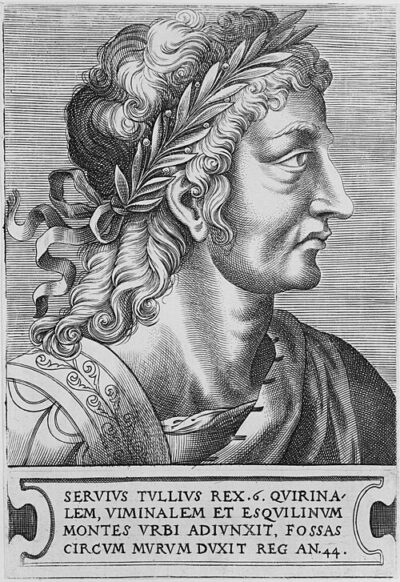
Servius Tullius
Servius Tullius was a legendary sixth king of Rome. Born 6th century BC, in Rome. Died 535 BC, in Rome. Positions held include King of Rome (-578–-534).
Facts
14 facts · 0 confirmed by two sources · 0 cited · 13 from one source · 1 where the sources disagree
What’s different
- Died: we show 535 BC (Sources disagree). Wikidata also lists 534 BC
Where this comes from
Papalocal keeps its own record. It started from these sources; what each one said is kept here as it was copied, so a change on their side never changes this page by itself. Tap one to read its version.
What Wikidata says · copied November 16, 2026 · revision 2547747319
- Described as
- legendary sixth king of Rome
- Other names
- Mastarna
- Born
- 6th century BC
- Died
- 535 BC; 534 BC
- Born in
- Rome
- Died in
- Rome
- Name at birth
- Mastarna
- Citizen of
- Ancient Rome
- Occupation
- politician
- Positions held
- King of Rome (-578–-534) · 1 reference
- Spouse
- Tarquinia the Elder; Gegania
- Children
- Tullia Major; Tullia Minor
- Father
- Tullius
- Mother
- Ocrisia
- Wikipedias with a page
- 54
Wikidata item Q192998 (wikidata.org/wiki/Q192998), public domain (CC0). Copied November 16, 2026.
What Wikipedia says · copied November 16, 2026 · revision 1374230547
Servius Tullius was the legendary sixth king of Rome, and the second of its Etruscan dynasty. He reigned from 578 to 535 BC. Roman and Greek sources describe his servile origins and later marriage to a daughter of Lucius Tarquinius Priscus, Rome's first Etruscan king, who was assassinated in 579 BC. The constitutional basis for his accession is unclear; he is variously described as the first Roman king to accede without election by the Senate, having gained the throne by popular and royal support; and as the first to be elected by the Senate alone, with support of the reigning queen but without recourse to a popular vote.
Several traditions describe Servius's father as divine. Livy depicts Servius's mother as a captured Latin princess enslaved by the Romans; her child is chosen as Rome's future king after a ring of fire is seen around his head. The Emperor Claudius discounted such origins and described him as an originally Etruscan mercenary, named Mastarna, who fought for Caelius Vibenna.
Servius was a popular king, and one of Rome's most significant benefactors. He had military successes against Veii and the Etruscans, and expanded the city to include the Quirinal, Viminal and Esquiline hills. He is traditionally credited with the institution of the Compitalia festivals, the building of temples to Fortuna and Diana and, less plausibly, the invention of Rome's first true coinage.
Despite the opposition of Rome's patricians, he expanded the Roman franchise and improved the lot and fortune of Rome's lowest classes of citizens and non-citizens. According to Livy, he reigned for 44 years, until murdered by his daughter Tullia and son-in-law Lucius Tarquinius Superbus. In consequence of this "tragic crime" and his hubristic arrogance as king, Tarquinius was eventually removed. This cleared the way for the abolition of Rome's monarchy and the founding of the Roman Republic, whose groundwork had already been laid by Servius's reforms.
From the Wikipedia article “Servius Tullius” (en.wikipedia.org/wiki/Servius_Tullius), by its contributors, under CC BY-SA 4.0 (creativecommons.org/licenses/by-sa/4.0/). Copied November 16, 2026; not changed.
Confirmed Two sources agree. Cited One source, and it names where it got it. One source One source, without a reference of its own. Sources disagree The sources disagree. We show the best-supported value and keep theirs below.
