
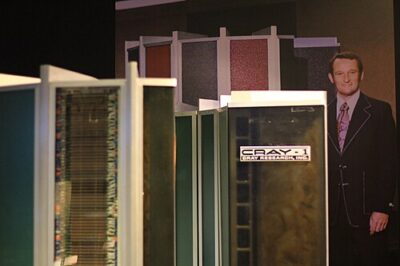
Seymour Cray
Seymour Cray was an Applied mathematician, computer scientist, and electrical engineer. Born September 28, 1925, in Chippewa Falls. Died October 5, 1996, in Colorado Springs. Educated at University of Minnesota and Chippewa Falls High School. Awards include IEEE Ernst Weber Engineering Leadership Recognition, Howard N. Potts Medal and National Inventors Hall of Fame.
Facts
22 facts · 2 confirmed by two sources · 4 cited · 16 from one source
Where this comes from
Papalocal keeps its own record. It started from these sources; what each one said is kept here as it was copied, so a change on their side never changes this page by itself. Tap one to read its version.
What Wikipedia says · copied November 13, 2026 · revision 1385517446
Seymour Roger Cray (September 28, 1925 – October 5, 1996) was an American electrical engineer, computer scientist, mathematician, and supercomputer architect who designed a series of computers that were the fastest in the world for decades, and founded Cray Research, which built many of these machines. Called "the father of supercomputing", Cray has been credited with creating the supercomputer industry. Joel S. Birnbaum, then chief technology officer of Hewlett-Packard, said of him: "It seems impossible to exaggerate the effect he had on the industry; many of the things that high performance computers now do routinely were at the farthest edge of credibility when Seymour envisioned them." Larry Smarr, then director of the National Center for Supercomputing Applications at the University of Illinois said that Cray is "the Thomas Edison of the supercomputing industry."
- Born, in its opening lines
- September 28, 1925
- Died, in its opening lines
- October 5, 1996
From the Wikipedia article “Seymour Cray” (en.wikipedia.org/wiki/Seymour_Cray), by its contributors, under CC BY-SA 4.0 (creativecommons.org/licenses/by-sa/4.0/). Copied November 13, 2026; not changed.
What Wikidata says · copied November 14, 2026 · revision 2568934415
- Described as
- Applied mathematician, computer scientist, and electrical engineer (1925–1996)
- Other names
- Seymour R. Cray, Seymour Roger Cray
- Born
- September 28, 1925 · 2 references
- Died
- October 5, 1996 · 2 references
- Born in
- Chippewa Falls
- Died in
- Colorado Springs
- Cause of death
- traffic collision
- Citizen of
- United States
- Occupation
- engineer; computer scientist; electrical engineer; applied mathematician; businessperson · 1 reference
- Worked for
- Control Data Corporation; Cray · 1 reference
- Education
- University of Minnesota; Chippewa Falls High School · 1 reference
- Awards
- IEEE Ernst Weber Engineering Leadership Recognition; Howard N. Potts Medal (1979) · 1 reference; National Inventors Hall of Fame (1997) · 1 reference; Eckert–Mauchly Award (1989) · 1 reference; W. Wallace McDowell Award (1968); Harry H. Goode Memorial Award (1972) · 2 references
- Field
- computer · 1 reference
- Wikipedias with a page
- 46
Wikidata item Q92765 (wikidata.org/wiki/Q92765), public domain (CC0). Copied November 14, 2026.
Confirmed Two sources agree. Cited One source, and it names where it got it. One source One source, without a reference of its own. Sources disagree The sources disagree. We show the best-supported value and keep theirs below.
