
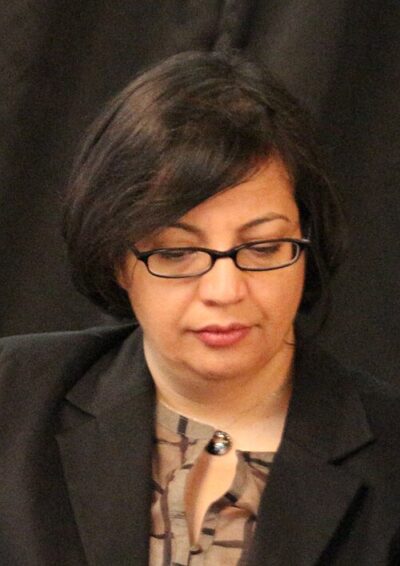
Shadi Sadr
Shadi Sadr is a Lawyer and women's rights activist. Born 1974, in Tehran. Educated at University of Tehran. Awards include International Women of Courage Award, Human rights defenders tulip and BBC 100 Women.
Facts
12 facts · 0 confirmed by two sources · 7 cited · 5 from one source
Where this comes from
Papalocal keeps its own record. It started from these sources; what each one said is kept here as it was copied, so a change on their side never changes this page by itself. Tap one to read its version.
What Wikidata says · copied November 17, 2026 · revision 2569235958
- Described as
- Lawyer and women's rights activist
- Born
- 1974 · 1 reference
- Born in
- Tehran · 1 reference
- Citizen of
- Iran
- Occupation
- journalist; lawyer · 1 reference; human rights defender · 1 reference; essayist · 1 reference; jurist · 1 reference
- Education
- University of Tehran
- Awards
- International Women of Courage Award (2010); Human rights defenders tulip (2009); BBC 100 Women (2013) · 1 reference
- Wikipedias with a page
- 25
Wikidata item Q6485256 (wikidata.org/wiki/Q6485256), public domain (CC0). Copied November 17, 2026.
What Wikipedia says · copied November 17, 2026 · revision 1383301891
Shadi Sadr (Persian: شادی صدر; born 1974) is an Iranian lawyer, human rights advocate, essayist and journalist. She co-founded Justice for Iran (JFI) in 2010 and is the Executive Director of the NGO. She has published and lectured worldwide.
She has received a number of awards including the Human Rights Tulip and Alexander Prize of Law School of Santa Clara University. In 2007 and 2009 she was detained in Evin prison. On 17 May 2010, she was convicted by the Tehran Revolutionary court of "acting against national security and harming public order".
From the Wikipedia article “Shadi Sadr” (en.wikipedia.org/wiki/Shadi_Sadr), by its contributors, under CC BY-SA 4.0 (creativecommons.org/licenses/by-sa/4.0/). Copied November 17, 2026; not changed.
Confirmed Two sources agree. Cited One source, and it names where it got it. One source One source, without a reference of its own. Sources disagree The sources disagree. We show the best-supported value and keep theirs below.
