
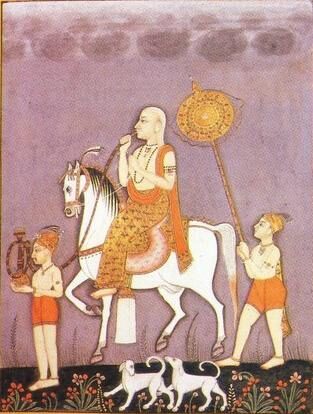
Shahu I
Shahu I was a Chhatrapati of India from 1708 to 1749. Born May 18, 1682. Died December 15, 1749, in Satara. Positions held include Chatrapati.
Facts
7 facts · 2 confirmed by two sources · 0 cited · 5 from one source
Where this comes from
Papalocal keeps its own record. It started from these sources; what each one said is kept here as it was copied, so a change on their side never changes this page by itself. Tap one to read its version.
What Wikidata says · copied November 18, 2026 · revision 2554606105
- Described as
- Chhatrapati of India from 1708 to 1749
- Other names
- Shahu Bhosale I, Shahu Bhonsle, Shahu The Great
- Born
- May 18, 1682
- Died
- December 15, 1749 · 1 reference
- Died in
- Satara
- Positions held
- Chatrapati
- Father
- Sambhaji
- Mother
- Maharani Yesubai
- Religion
- Hinduism
- Wikipedias with a page
- 20
Wikidata item Q3633171 (wikidata.org/wiki/Q3633171), public domain (CC0). Copied November 18, 2026.
What Wikipedia says · copied November 18, 2026 · revision 1376308633
Shahu I (18 May 1682 – 15 December 1749) was the fifth Chhatrapati of Maratha Empire from 1708 to 1749, the longest reign among the Maratha rulers. He was also the last subahdar of the Bijapur Subah, before being annexed by the Maratha Empire. During Shahu's reign, driven largely by the strategic vision and military leadership of his Peshwas, the Maratha Empire expanded across much of the Indian subcontinent and emerged as the leading power in South Asia.
Shahu, his father Sambhaji I and his grandfather Shivaji Maharaj, all belonged to the Bhonsle dynasty. He, along with his mother Yesubai Bhonsle, was under the capture of Aurangzeb during the Deccan Wars. For nearly 18 years, Shahu was under captive but was treated with royal courtesy and he was often involved in Mughal politics. By 1707, Shahu was released by Aurangzeb's son Bahadur Shah I, in order to strengthen Mughal relations with the Marathas. Shahu held military and administrative posts during his captive days in the Mughal Empire eventually becoming the governor of the Bijapur Subah. Shahu succeeded his cousin Shivaji II by 1708 at the age of 26, shortly after Aurangzeb's death and his release. Then, Shahu launched military campaigns on the regions of Khed, Adilabad, Konkan, Bengal, Bihar and western Indian subcontinent. He also successfully brought them under control of the Marathas, with the exception of Bengal which was only partly incorporated into the empire. One of his most successful and famous campaigns were during at the Afsharid invasion of India in which the Afsharid Empire, under the rule of Nader Shah, occupied Delhi and the remaining western territories of an insignificant Mughal Empire. Marathas, under the rule of Shahu, helped the Mughals against the Persian Afsharid dynasty. By 1740, the combined forces of the Marathas and Mughals and other smaller regional powers defeated the Persians in the subcontinent and thereby, forcing Nader Shah's huge army to retreat from Lahore and western Indian subcontinent (Afghanistan, Khyber Pakhtunkhwa, Pakistan and Punjab) and ceded all their territories in India to the Marathas. Thus, the Maratha Empire eventually captured Delhi and became the sole dominant power in South Asia, replacing the Mughals which had been the dominant power in the region for over three centuries, and making them puppets of the Marathas.
Shahu also introduced Mughal and western-styled form of administration into the Maratha Empire. He divided his empire into subahs (provinces), a system which was introduced by Akbar in the Mughal Empire. During Shahu's reign, the central authority of the empire became much stronger and the empire was highly centralized, with the Chhatrapati being the head of the state. Shahu was a great patron of many Indian languages, such as Marathi, Hindustani, Persian, Sanskrit, Prakrit and Tamil. He also made Hindustani as the dominant language in the empire's court, alongside his dynastic language, Marathi. He also issued coins in Persian, Prakrit, Sanskrit and French languages. The empire, under Shahu, started making trade contacts and strong relations with powers outside South Asia such as Britain, France, Iran and others. Because of all these reforms, he is called as Maharaj e-Hind (مهاراجِ هند) or Padishah e-Hind (پادشاه هند) in Persian and Hindustani languages, making him the only Maratha emperor to carry these titles.
Shahu died in 1749 at the age of 67, due to a sudden heart attack and was succeeded by his son, Rajaram II. Some historians often claims that the decline of the Maratha Empire took place after his death but these citations are often dismissed as the empire still continued to be an effective power in Asia during the reign of Rajaram II. However, Shahu's death was a significant blow to the empire. After his death, the power was passed into the hands of the Peshwa and the Chhatrapati was reduced to a figurehead. The central authority grew weaker and the Maratha Empire was decentralized into several houses of powers such as Holkars in Indore and Delhi, Scindias in Gwalior and Sind and Gaekwads in Baroda and Bhopal, which were ruled by the Peshwa and the Ashta Pradhan.
- Born, in its opening lines
- May 18, 1682
- Died, in its opening lines
- December 15, 1749
From the Wikipedia article “Shahu I” (en.wikipedia.org/wiki/Shahu_I), by its contributors, under CC BY-SA 4.0 (creativecommons.org/licenses/by-sa/4.0/). Copied November 18, 2026; not changed.
Confirmed Two sources agree. Cited One source, and it names where it got it. One source One source, without a reference of its own. Sources disagree The sources disagree. We show the best-supported value and keep theirs below.
