
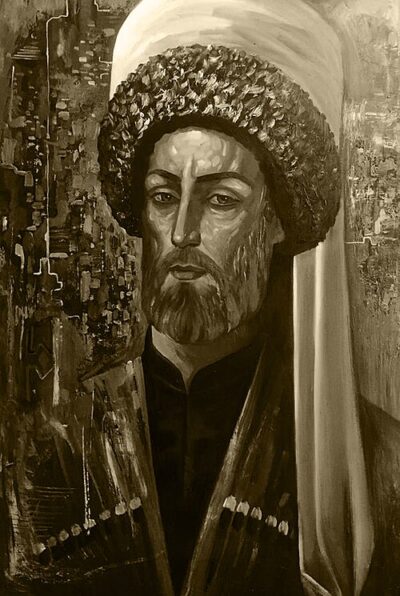
Sheikh Mansur
Sheikh Mansur was a military general and politician. Born June 1762. Died April 13, 1794, in Oreshek Fortress.
Facts
13 facts · 1 confirmed by two sources · 2 cited · 9 from one source · 1 where the sources disagree
What’s different
- Born: we show June 1762 (Sources disagree). Wikipedia says c. 1760
Where this comes from
Papalocal keeps its own record. It started from these sources; what each one said is kept here as it was copied, so a change on their side never changes this page by itself. Tap one to read its version.
What Wikidata says · copied November 16, 2026 · revision 2554586429
- Described as
- military general and politician (1760-1794)
- Born
- June 1762
- Died
- April 13, 1794
- Died in
- Oreshek Fortress · 1 reference
- Buried in
- Leningrad Oblast · 1 reference
- Citizen of
- Chechnya
- Occupation
- rebel; politician; imam · 1 reference; resistance fighter · 1 reference; cleric · 1 reference
- Religion
- Sunni Islam; Naqshbandi · 1 reference
- Military rank
- military leader · 1 reference
- Wikipedias with a page
- 29
Wikidata item Q1849933 (wikidata.org/wiki/Q1849933), public domain (CC0). Copied November 16, 2026.
What Wikipedia says · copied November 16, 2026 · revision 1368408590
Sheikh Mansur (born Ushurma or Uchermak, c. 1760 – 13 April 1794) was a Chechen military commander and Islamic leader who led a resistance movement against Russian expansion into the Caucasus from 1785 until his capture in 1791. Sheikh Mansur is considered the first leader of the resistance in the North Caucasus against Russian imperialism. He remains a hero of the Chechen and North Caucasian peoples in general, and their struggle for independence.
- Born, in its opening lines
- c. 1760
- Died, in its opening lines
- April 13, 1794
From the Wikipedia article “Sheikh Mansur” (en.wikipedia.org/wiki/Sheikh_Mansur), by its contributors, under CC BY-SA 4.0 (creativecommons.org/licenses/by-sa/4.0/). Copied November 16, 2026; not changed.
Confirmed Two sources agree. Cited One source, and it names where it got it. One source One source, without a reference of its own. Sources disagree The sources disagree. We show the best-supported value and keep theirs below.
