
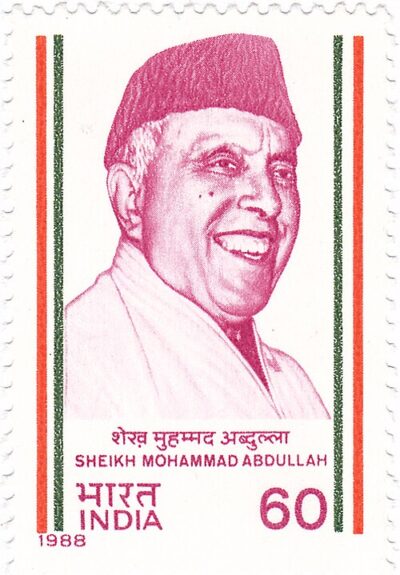
Sheikh Muhammad Abdullah
Sheikh Muhammad Abdullah was a Kashmiri politician. Born December 5, 1905, in Soura. Died September 8, 1982, in Srinagar. Positions held include member of the Jammu and Kashmir Legislative Assembly, Member of the Constituent Assembly of India (1946–1950) and Chief Minister of Jammu and Kashmir (2 times) (1948–1982). Educated at Islamia College and Aligarh Muslim University. Awards include Sahitya Akademi Award in Urdu.
Facts
23 facts · 2 confirmed by two sources · 4 cited · 17 from one source
Where this comes from
Papalocal keeps its own record. It started from these sources; what each one said is kept here as it was copied, so a change on their side never changes this page by itself. Tap one to read its version.
What Wikidata says · copied November 16, 2026 · revision 2563519265
- Described as
- Kashmiri politician (1905-1982)
- Other names
- Sheikh Mohammed Abdullah, Sheikh Mohammad Abdullah, Sheikh Abdullah
- Born
- December 5, 1905 · 6 references
- Died
- September 8, 1982 · 4 references
- Born in
- Soura · 2 references
- Died in
- Srinagar · 1 reference
- Citizen of
- India (1950–); British Raj (–1947); Dominion of India (1947–1950)
- Occupation
- politician; chemist · 1 reference; writer
- Positions held
- member of the Jammu and Kashmir Legislative Assembly; Member of the Constituent Assembly of India (1946–1950); Chief Minister of Jammu and Kashmir (2 times) (1948–1982)
- Political party
- Jammu & Kashmir National Conference
- Education
- Islamia College; Aligarh Muslim University; Sri Pratap College
- Awards
- Sahitya Akademi Award in Urdu (1988) · 1 reference
- Spouse
- Begum Akbar Jahan Abdullah
- Children
- Farooq Abdullah; Khalida Shah · 1 reference; Sheikh Mustafa Kamal
- Religion
- Islam
- Wikipedias with a page
- 30
Wikidata item Q983328 (wikidata.org/wiki/Q983328), public domain (CC0). Copied November 16, 2026.
What Wikipedia says · copied November 16, 2026 · revision 1385750999
Sheikh Mohammad Abdullah (5 December 1905 – 8 September 1982) was an Indian politician who played a central role in the politics of Jammu and Kashmir. Abdullah was the founding leader and President of the All Jammu and Kashmir Muslim Conference (later renamed Jammu and Kashmir National Conference). He agitated against the rule of the Maharaja Hari Singh and urged self-rule for Kashmir. He is also known as Sher-e-Kashmir ("Lion of Kashmir") and Father of the State of Jammu & Kashmir ("Baba-e-Qaum").
He served as the first elected Prime Minister of the Princely State of Jammu and Kashmir and Jammu & Kashmir as a State and was later jailed by Indian government citing his support to insurgents. He was dismissed from the position of Prime Minister on 8 August 1953 and Bakshi Ghulam Mohammad was appointed the new prime minister. The expressions 'Sadr-i-Riyasat' and 'Prime Minister' were replaced with the terms 'Governor' and 'Chief Minister' in 1965. Sheikh Abdullah again became the Chief Minister of the state following the accord with Indira Gandhi in 1974 and remained in the top slot until his death on 8 September 1982. His grandson Omar Abdullah is currently the chief minister of Jammu & Kashmir.
- Born, in its opening lines
- December 5, 1905
- Died, in its opening lines
- September 8, 1982
From the Wikipedia article “Sheikh Abdullah” (en.wikipedia.org/wiki/Sheikh_Abdullah), by its contributors, under CC BY-SA 4.0 (creativecommons.org/licenses/by-sa/4.0/). Copied November 16, 2026; not changed.
Confirmed Two sources agree. Cited One source, and it names where it got it. One source One source, without a reference of its own. Sources disagree The sources disagree. We show the best-supported value and keep theirs below.
