
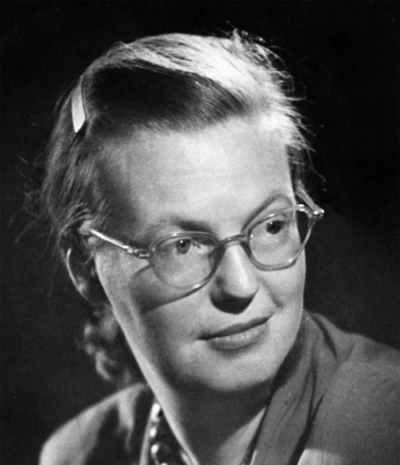
Shirley Jackson
Shirley Jackson was an American writer. Born December 14, 1916, in San Francisco. Died August 8, 1965, in North Bennington. Educated at Syracuse University and University of Rochester. Awards include Edgar Awards and Bram Stoker Award for Best Anthology.
Facts
26 facts · 2 confirmed by two sources · 7 cited · 17 from one source
What’s different
- Died: we show August 8, 1965 (Confirmed). Wikidata also lists September 8, 1965
Where this comes from
Papalocal keeps its own record. It started from these sources; what each one said is kept here as it was copied, so a change on their side never changes this page by itself. Tap one to read its version.
What Wikidata says · copied November 13, 2026 · revision 2565552381
- Described as
- American writer (1916-1965)
- Other names
- Shirley Hardie Jackson
- Born
- December 14, 1916 · 9 references
- Died
- August 8, 1965 · 1 reference; September 8, 1965 · 1 reference
- Born in
- San Francisco · 3 references
- Died in
- North Bennington · 1 reference
- Cause of death
- heart failure
- Citizen of
- United States
- Occupation
- journalist; novelist; writer · 2 references; non-fiction writer; children's writer
- Education
- Syracuse University (–1940); University of Rochester; Brighton High School · 1 reference; Burlingame High School · 1 reference
- Genre
- horror literature; detective fiction · 1 reference; memoir · 1 reference; Gothic literature · 1 reference; feminist science fiction
- Awards
- Edgar Awards (1961); Bram Stoker Award for Best Anthology (2021) · 1 reference
- Spouse
- Stanley Edgar Hyman (1940–1965) · 1 reference
- Children
- Laurence Jackson Hyman · 1 reference
- Lived in
- San Francisco
- Website
- http://shirleyjackson.org/ · 1 reference
- Wikipedias with a page
- 45
Wikidata item Q239910 (wikidata.org/wiki/Q239910), public domain (CC0). Copied November 13, 2026.
What Wikipedia says · copied November 13, 2026 · revision 1385300816
Shirley Hardie Jackson (December 14, 1916 – August 8, 1965) was an American writer known primarily for her works of horror and mystery. Her writing career spanned over two decades, during which she composed six novels, two memoirs, and more than 200 short stories.
Born in San Francisco, California, Jackson attended Syracuse University in New York, where she became involved with the university's literary magazine and met her future husband Stanley Edgar Hyman. After they graduated, the couple moved to New York City and began contributing to The New Yorker, with Jackson as a fiction writer and Hyman as a contributor to "Talk of the Town". The couple settled in North Bennington, Vermont, in 1945, after the birth of their first child, when Hyman joined the faculty of Bennington College.
After publishing her debut novel, The Road Through the Wall (1948), a semi-autobiographical account of her childhood in California, Jackson gained significant public attention for her short story "The Lottery", which presents the sinister underside of a bucolic American village. She continued to publish numerous short stories in literary journals and magazines throughout the 1950s, some of which were assembled and reissued in her 1953 memoir Life Among the Savages. In 1959, she published The Haunting of Hill House, a supernatural horror novel widely considered to be one of the best ghost stories ever written. Jackson's final work, the 1962 novel We Have Always Lived in the Castle, is a Gothic psychological horror novel that has been described as her masterpiece.
By the 1960s, Jackson's health began to deteriorate significantly, ultimately leading to her death due to a heart condition in 1965 at the age of 48.
- Born, in its opening lines
- December 14, 1916
- Died, in its opening lines
- August 8, 1965
From the Wikipedia article “Shirley Jackson” (en.wikipedia.org/wiki/Shirley_Jackson), by its contributors, under CC BY-SA 4.0 (creativecommons.org/licenses/by-sa/4.0/). Copied November 13, 2026; not changed.
Confirmed Two sources agree. Cited One source, and it names where it got it. One source One source, without a reference of its own. Sources disagree The sources disagree. We show the best-supported value and keep theirs below.
