
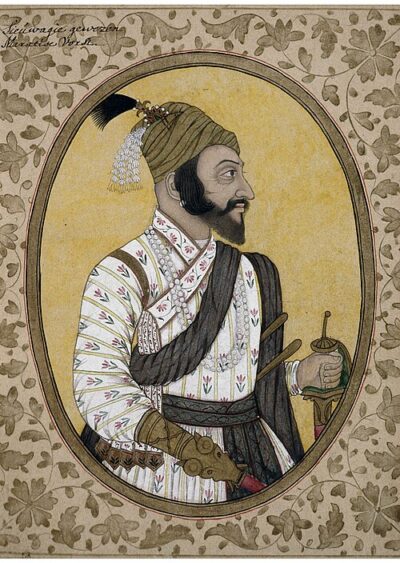
Shivaji
Shivaji was an Indian Maratha king and founder of the Maratha Swaraj (Empire). Born February 19, 1627, in Shivneri Fort. Died April 3, 1680, in Raigad Fort. Positions held include Chatrapati (1674–1680).
Facts
17 facts · 1 confirmed by two sources · 5 cited · 10 from one source · 1 where the sources disagree
What’s different
- Born: we show February 19, 1627 (Sources disagree). Wikipedia says February 19, 1630
Where this comes from
Papalocal keeps its own record. It started from these sources; what each one said is kept here as it was copied, so a change on their side never changes this page by itself. Tap one to read its version.
What Wikidata says · copied November 16, 2026 · revision 2565546976
- Described as
- Indian Maratha king and founder of the Maratha Swaraj (Empire)
- Other names
- Chatrapati Shivaji Raje Bhosale, God of Maratha’s, Chhatrapati Shivaji Maharaj, Shivaji Bhosale I, Shivba
- Born
- February 19, 1627 · 1 reference
- Died
- April 3, 1680 · 1 reference
- Born in
- Shivneri Fort
- Died in
- Raigad Fort
- Cause of death
- anthrax
- Occupation
- emperor (1674–1680)
- Positions held
- Chatrapati (1674–1680) · 1 reference
- Spouse
- Saibai (1641–) · 1 reference; Putalabai (1653–) · 1 reference; Sakavaarbai (1657–) · 1 reference; Soyarabai
- Children
- Sambhaji · 1 reference; Rajaram I · 1 reference
- Father
- Shahaji
- Mother
- Jijabai
- Siblings
- Sambhaji Shahaji Bhosale
- Religion
- Hinduism
- Wikipedias with a page
- 70
Wikidata item Q239505 (wikidata.org/wiki/Q239505), public domain (CC0). Copied November 16, 2026.
What Wikipedia says · copied November 16, 2026 · revision 1383099432
Shivaji I (Shivaji Shahaji Bhonsale, Marathi pronunciation: [ʃiˈʋaːdʑiː ˈbʱos(ə)le]; c. 19 February 1630 – 3 April 1680) was an Indian ruler and a member of the Bhonsle dynasty. Shivaji inherited a fiefdom (Marathi: Jagir) from his father who served as a retainer for the Sultanate of Bijapur, which later formed the genesis of the Maratha Kingdom. In 1674, he was formally crowned the Chhatrapati of his realm at Raigad Fort.
Shivaji offered passage and his service to the Mughal emperor Aurangzeb to invade the declining Sultanate of Bijapur. After Aurangzeb's departure for the north due to a war of succession, Shivaji conquered territories ceded by Bijapur in the name of the Mughals. Following his defeat at the hands of Jai Singh I in the Battle of Purandar, Shivaji entered into vassalage with the Mughal empire, assuming the role of a Mughal chief. During this time Shivaji also wrote a series of letters apologising to Mughal emperor Aurangzeb for his actions and requested additional honors for his services. He was later conferred with the title of Raja by the emperor. He undertook military expeditions on behalf of the Mughal Empire for a brief duration.
In 1674, Shivaji was crowned as the king despite opposition from local Brahmins. Shivaji employed people of all castes and religions, including Muslims and Europeans, in his administration and armed forces. Over the course of his life, Shivaji engaged in both alliances and hostilities with the Mughal Empire, the Sultanate of Golconda, the Sultanate of Bijapur and the European colonial powers. Shivaji's military forces expanded the Maratha sphere of influence, capturing and building forts, and forming a Maratha navy.
Shivaji's legacy was revived by Jyotirao Phule about two centuries after his death. Later on, he came to be glorified by Indian nationalists such as Bal Gangadhar Tilak, and appropriated by Hindutva activists.
- Born, in its opening lines
- February 19, 1630
- Died, in its opening lines
- April 3, 1680
From the Wikipedia article “Shivaji” (en.wikipedia.org/wiki/Shivaji), by its contributors, under CC BY-SA 4.0 (creativecommons.org/licenses/by-sa/4.0/). Copied November 16, 2026; not changed.
Confirmed Two sources agree. Cited One source, and it names where it got it. One source One source, without a reference of its own. Sources disagree The sources disagree. We show the best-supported value and keep theirs below.
