
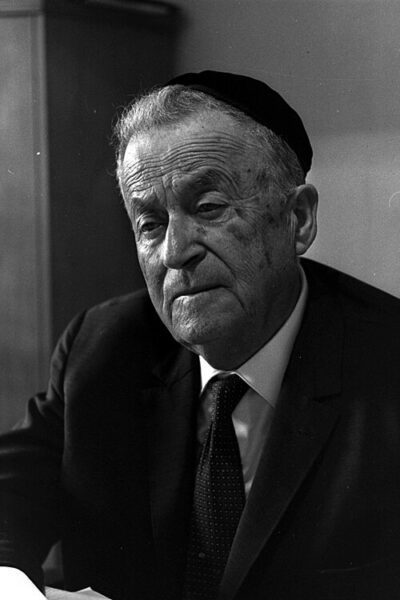
Shmuel Yosef Agnon
Shmuel Yosef Agnon was an Ukrainian-born Israeli Hebrew writer, Nobel laureate in Literature. Born August 8, 1887, in Buchach. Died February 17, 1970, in Jerusalem. Known for Tel ou tel, The Bridal Canopy and Invité pour la Nuit. Awards include Nobel Prize in Literature, Bialik Prize (2 times) and Israel Prize (2 times).
Facts
29 facts · 2 confirmed by two sources · 10 cited · 17 from one source
Where this comes from
Papalocal keeps its own record. It started from these sources; what each one said is kept here as it was copied, so a change on their side never changes this page by itself. Tap one to read its version.
What Wikidata says · copied November 16, 2026 · revision 2565593363
- Described as
- Ukrainian-born Israeli Hebrew writer, Nobel laureate in Literature (1888–1970)
- Other names
- Samuel Josef Agnon, Samuel Joseph Agnon
- Born
- August 8, 1887 · 1 reference
- Died
- February 17, 1970 · 12 references
- Born in
- Buchach · 1 reference
- Died in
- Jerusalem · 1 reference
- Buried in
- Mount of Olives Jewish Cemetery · 1 reference
- Name at birth
- שמואל יוסף הלוי טשאטשקיס
- Citizen of
- German Empire; Weimar Republic; Mandatory Palestine; Israel
- Occupation
- writer · 2 references; novelist · 1 reference; poet · 1 reference; short story writer
- Known for
- Tel ou tel; The Bridal Canopy; Invité pour la Nuit; Those Were the Days; Une histoire simple; Days of Awe; Samuch ve-Nir'eh
- Awards
- Nobel Prize in Literature (1966) · 3 references; Bialik Prize (2 times) (1934, 1950) · 1 reference; Israel Prize (2 times) (1954, 1958) · 2 references; honorary doctorate of the Weizmann Institute of Science; honorary citizen of Jerusalem (1962); Newman Prize (1963)
- Spouse
- Esther Agnon · 1 reference
- Children
- Emuna Yaron · 1 reference
- Wikipedias with a page
- 97
Wikidata item Q133042 (wikidata.org/wiki/Q133042), public domain (CC0). Copied November 16, 2026.
What Wikipedia says · copied November 16, 2026 · revision 1385844222
Shmuel Yosef Agnon (Hebrew: שמואל יוסף עגנון \ שְׁמוּאֵל יוֹסֵף עַגְנוֹן shmuél yoséf agnón; August 8, 1887 – February 17, 1970) was an Austro-Hungarian-born Israeli novelist, poet, and short-story writer. He was one of the central figures of modern Hebrew literature. In Hebrew, he is known by the nom de plume Shai Agnon (Hebrew: ש״י עגנון \ שַׁ״י עַגְנוֹן sháy agnón). In English, his works are published under the name S. Y. Agnon.
Agnon was born in Eastern Galicia, then part of the Austro-Hungarian Empire, and later immigrated to Mandatory Palestine, and died in Jerusalem.
His works deal with the conflict between the traditional Jewish life and language and the modern world. They also attempt to recapture the fading traditions of the European shtetl 'small town' (cf. Yiddish: שטאָט shtot 'town, city', שטעטל shtetl 'little town', דאָרף dorf 'village'). In a wider context, he also contributed to broadening the characteristic conception of the narrator's role in literature. Agnon had a distinctive linguistic style, mixing modern and rabbinic Hebrew.
In 1966, he shared the Nobel Prize in Literature with the poet Nelly Sachs.
- Born, in its opening lines
- August 8, 1887
- Died, in its opening lines
- February 17, 1970
From the Wikipedia article “Shmuel Yosef Agnon” (en.wikipedia.org/wiki/Shmuel_Yosef_Agnon), by its contributors, under CC BY-SA 4.0 (creativecommons.org/licenses/by-sa/4.0/). Copied November 16, 2026; not changed.
Confirmed Two sources agree. Cited One source, and it names where it got it. One source One source, without a reference of its own. Sources disagree The sources disagree. We show the best-supported value and keep theirs below.
