
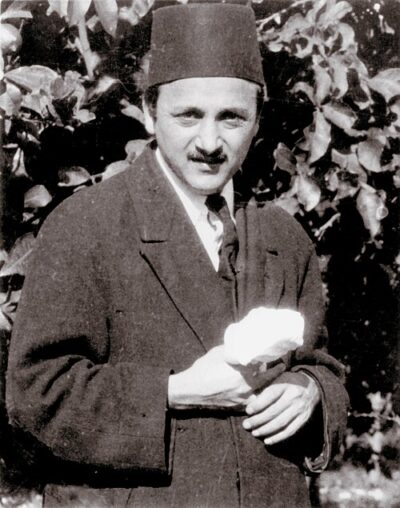
Shoghi Effendi
Shoghi Effendi was a grandson of ʻAbdu'l-Bahá, head of the Bahá'í Faith from 1921 until his death in 1957. Born March 1, 1897, in Acre. Died November 4, 1957, in London. Educated at Balliol College and American University of Beirut.
Facts
15 facts · 0 confirmed by two sources · 7 cited · 8 from one source
Where this comes from
Papalocal keeps its own record. It started from these sources; what each one said is kept here as it was copied, so a change on their side never changes this page by itself. Tap one to read its version.
What Wikidata says · copied November 16, 2026 · revision 2568111943
- Described as
- grandson of ʻAbdu'l-Bahá, head of the Bahá'í Faith from 1921 until his death in 1957
- Born
- March 1, 1897 · 3 references
- Died
- November 4, 1957 · 3 references
- Born in
- Acre · 1 reference
- Died in
- London · 1 reference
- Buried in
- London
- Cause of death
- influenza A virus subtype H1N1 · 1 reference
- Citizen of
- Palestine
- Occupation
- religious leader; Guardian of the Bahá'í Faith; translator; Baháʼí · 1 reference
- Education
- Balliol College; American University of Beirut · 1 reference
- Spouse
- Rúhíyyih Khanum · 1 reference
- Religion
- Baháʼí Faith
- Wikipedias with a page
- 39
Wikidata item Q318441 (wikidata.org/wiki/Q318441), public domain (CC0). Copied November 16, 2026.
What Wikipedia says · copied November 16, 2026 · revision 1381145380
Shoghí Effendi (; Persian: شوقی افندی; 1896 or 1897 – 4 November 1957) was Guardian of the Baháʼí Faith from 1922 until his death in 1957. As the grandson and successor of ʻAbdu'l-Bahá, he was charged with guiding the development of the Baháʼí Faith, including the creation of its global administrative structure and the prosecution of Baháʼí teaching plans that oversaw the expansion of the religion to several new countries. As the authorized interpreter of the Baháʼí literature, he translated the primary written works of the Faith's central figures, providing unity of understanding of its essential teachings and safeguarding its followers from division. Upon his death in 1957, leadership passed to the Hands of the Cause, and in 1963 the Baháʼís of the world elected the Universal House of Justice, an institution which had been described and planned by Baháʼu’llah.
Shoghi Effendi, an Afnán, was born Shoghí Rabbání in Acre in the Ottoman Empire, where he spent his early life, but later went on to study in Haifa and Beirut, gaining an arts degree from the Syrian Protestant College in 1918 and then serving as ʻAbdu'l-Bahá's secretary and translator. In 1920, he attended Balliol College, Oxford, where he studied political science and economics. Before completing his studies, news of ʻAbdu'l-Bahá's death reached him, requiring him to return to Haifa. Shortly after his return at the end of December 1921, he learned that the Will and Testament of ʻAbdu'l-Bahá named him Guardian of the Baháʼí Faith. Two crucial aspects of his leadership focused on building the administration and spreading the faith worldwide.
During his 36 years as Guardian, Shoghi Effendi translated and expounded on many of the writings of Bahá’u’lláh and ʻAbdu'l-Bahá, established plans that enabled the faith to spread globally and sent more than 17,500 letters. He kept in touch with progress in all existing Bahá’i communities as well as monitoring and responding to the situation in the Middle East, where the believers were still suffering persecution. He also began work to establish Haifa, Israel, as the Bahá’i World Center. He created an International Bahá’i Council to aid him in his work, several members of which were newly appointed Hands of the Cause. He also presided over the community's expansion from 1,034 localities in 1935 to 2,700 in 1953, and further to 14,437 in 1963. From the beginning to the end of his leadership, the total population of Baháʼís around the world grew from 100,000 to 400,000.
Shoghi Effendi died during a visit to London in 1957, having contracted Asian flu, and is buried at New Southgate Cemetery in the city of London.
From the Wikipedia article “Shoghi Effendi” (en.wikipedia.org/wiki/Shoghi_Effendi), by its contributors, under CC BY-SA 4.0 (creativecommons.org/licenses/by-sa/4.0/). Copied November 16, 2026; not changed.
Confirmed Two sources agree. Cited One source, and it names where it got it. One source One source, without a reference of its own. Sources disagree The sources disagree. We show the best-supported value and keep theirs below.
