
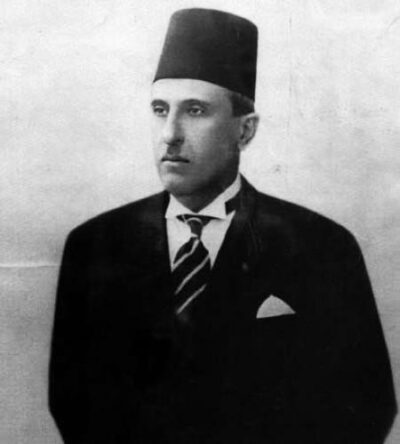
Shukri al-Quwatli
Shukri al-Quwatli was the 1st President of Syrian Republic. Born October 21, 1891, in Damascus. Died 1967, in Beirut. Positions held include President of the Syrian Republic under French mandate (1943–1946) and President of Syria (2 times) (1946–1958).
Facts
17 facts · 1 confirmed by two sources · 1 cited · 14 from one source · 1 where the sources disagree
What’s different
- Born: we show October 21, 1891 (Sources disagree). Wikipedia says May 6, 1891
- Died: we show 1967 (Confirmed). Wikidata also lists June 30, 1967
Where this comes from
Papalocal keeps its own record. It started from these sources; what each one said is kept here as it was copied, so a change on their side never changes this page by itself. Tap one to read its version.
What Wikidata says · copied November 16, 2026 · revision 2563056480
- Described as
- 1st President of Syrian Republic (1891–1967)
- Other names
- Shukrī al-Quwwatlī
- Born
- October 21, 1891 · 1 reference
- Died
- 1967 · 4 references; June 30, 1967
- Born in
- Damascus
- Died in
- Beirut
- Buried in
- Bab al-Saghir Cemetery
- Cause of death
- myocardial infarction
- Citizen of
- Ottoman Empire (–1918); Arab Kingdom of Syria (1918–1920); State of Damascus (1920–1925); State of Syria (1925–1930)
- Occupation
- politician · 1 reference
- Positions held
- President of the Syrian Republic under French mandate (1943–1946); President of Syria (2 times) (1946–1958)
- Political party
- National Bloc (–1947); National Party (1947–)
- Spouse
- Bahira al-Dalati
- Religion
- Islam
- Wikipedias with a page
- 32
Wikidata item Q59981 (wikidata.org/wiki/Q59981), public domain (CC0). Copied November 16, 2026.
What Wikipedia says · copied November 16, 2026 · revision 1382877916
Shukri al-Quwatli (Arabic: شكري القوّتلي, romanized: Shukrī al-Quwwatlī; 6 May 1891 – 30 June 1967) was a Syrian politician and statesman who was the first president of post-independence Syria, in 1943.
He began his career as a dissident working towards the independence and unity of the Ottoman Empire's Arab territories and was consequently imprisoned and tortured for his activism. When the Kingdom of Syria was established, Quwatli became a government official, though he was disillusioned with monarchism and co-founded the republican Independence Party. Quwatli was immediately sentenced to death by the French who took control over Syria in 1920, following the Franco-Syrian War. Afterward, he based himself in Cairo where he served as the chief ambassador of the Syrian-Palestinian Congress, cultivating particularly strong ties with Saudi Arabia. Quwatli utilized his connections with Saudi Arabia to help finance the Great Syrian Revolt (1925–1927). In 1930, the French authorities pardoned Quwatli and thereafter, he returned to Syria, where he gradually became a principal leader of the National Bloc. He was elected president of Syria in 1943 and oversaw the country's independence three years later.
Quwatli was reelected in 1948, but was toppled in a military coup in 1949 by Husni al-Za'im. He subsequently went into exile in Egypt, returning to Syria in 1955 to participate in the presidential election, which he won. A conservative presiding over an increasingly leftist-dominated government, Quwatli officially adopted neutralism amid the Cold War. After his request for aid from the United States was denied, he drew closer to the Eastern bloc. He also entered Syria into a defense arrangement with Egypt and Saudi Arabia to confront the influence of the Baghdad Pact. In 1957, Quwatli, who the US and the Pact countries attempted but failed to oust, sought to stem the leftist tide in Syria, but to no avail. By then, his political authority had receded as the military bypassed Quwatli's jurisdiction by independently coordinating with Quwatli's erstwhile ally, Egyptian president Gamal Abdel Nasser.
Following months of unity talks, in 1958, Quwatli merged Syria with Egypt to form the United Arab Republic and stepped down for Nasser to serve as president. In gratitude, Nasser awarded Quwatli the honorary title of "First Arab Citizen". However, Quwatli grew disenchanted with the union, believing it had reduced Syria to a police state subordinate to Egypt. He backed Syria's secession in 1961, but plans for him to complete his presidential term afterward did not materialize. Quwatli left Syria following the 1963 Ba'athist coup, and he died of a heart attack in Lebanon weeks after Syria's defeat in the 1967 Six-Day War. He was buried in Damascus on 1 July.
- Born, in its opening lines
- May 6, 1891
- Died, in its opening lines
- June 30, 1967
From the Wikipedia article “Shukri al-Quwatli” (en.wikipedia.org/wiki/Shukri_al-Quwatli), by its contributors, under CC BY-SA 4.0 (creativecommons.org/licenses/by-sa/4.0/). Copied November 16, 2026; not changed.
Confirmed Two sources agree. Cited One source, and it names where it got it. One source One source, without a reference of its own. Sources disagree The sources disagree. We show the best-supported value and keep theirs below.
