
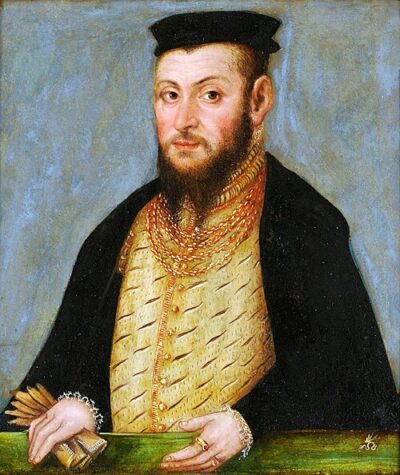
Sigismund II Augustus
Sigismund II Augustus was a King of Poland and Grand Duke of Lithuania. Born August 1, 1520, in Kraków. Died July 7, 1572, in Knyszyn. Positions held include King of Poland (1530–1572).
Facts
25 facts · 2 confirmed by two sources · 6 cited · 17 from one source
Where this comes from
Papalocal keeps its own record. It started from these sources; what each one said is kept here as it was copied, so a change on their side never changes this page by itself. Tap one to read its version.
What Wikidata says · copied November 16, 2026 · revision 2568891991
- Described as
- King of Poland and Grand Duke of Lithuania
- Born
- August 1, 1520 · 3 references
- Died
- July 7, 1572 · 2 references
- Born in
- Kraków · 2 references
- Died in
- Knyszyn · 2 references
- Buried in
- Wawel Cathedral
- Citizen of
- Kingdom of Poland; Grand Duchy of Lithuania
- Occupation
- statesperson
- Positions held
- King of Poland (1530–1572)
- Spouse
- Elizabeth of Austria (1543–) · 1 reference; Barbara Radziwiłł (1547–) · 4 references; Catherine of Austria (1553–) · 1 reference
- Children
- Barbara Woroniecka · 1 reference
- Father
- Sigismund I the Old · 1 reference
- Mother
- Bona Sforza · 1 reference
- Siblings
- Anna Jagiellon; Regina Szafraniec; Catherine Jagellon; Anna Jagiellon; Isabella Jagiellon; Sophia Jagiellon, Duchess of Brunswick-Lüneburg; Katharina of Poland, Countess of Montfort; Hedwig Jagiellon, Electress of Brandenburg; Wojciech Olbracht; John Jagiellon
- Wikipedias with a page
- 55
Wikidata item Q54058 (wikidata.org/wiki/Q54058), public domain (CC0). Copied November 16, 2026.
What Wikipedia says · copied November 16, 2026 · revision 1375049452
Sigismund II Augustus (Polish: Zygmunt II August, Lithuanian: Žygimantas Augustas; 1 August 1520 – 7 July 1572) was King of Poland and Grand Duke of Lithuania, the son of Sigismund I the Old, whom Sigismund II succeeded in 1548. He was the first ruler of the Polish–Lithuanian Commonwealth and the last male monarch from the Jagiellonian dynasty.
Sigismund was the elder of two sons of Italian-born Bona Sforza and Sigismund the Old, and the only one to survive infancy. From the beginning, he was groomed and extensively educated as a successor. In 1529, he was chosen as king in vivente rege election while his father was still alive. Sigismund Augustus continued a tolerance policy towards minorities and maintained peaceful relations with neighbouring countries, with the exception of the Northern Seven Years' War, which aimed to secure Baltic trade. Under his patronage, culture flourished in Poland; he was a collector of tapestries from the Low Countries and collected military memorabilia as well as swords, armour, and jewellery. Sigismund Augustus' rule is widely considered the apex of the Polish Golden Age; he established the first regular Polish navy and the first regular postal service in Poland, known today as Poczta Polska. In 1569, he oversaw the signing of the Union of Lublin between Poland and the Grand Duchy of Lithuania, which formed the Polish–Lithuanian Commonwealth.
Sigismund II Augustus married three times; his first wife, Elizabeth of Austria, died in 1545 at just 18. He was then involved in several relationships with mistresses, the most famous being Barbara Radziwiłł, who became Sigismund II's second wife and Queen of Poland in spite of his mother's disapproval. The marriage was deemed scandalous and was fiercely opposed by the royal court and the nobility. Barbara died five months after her coronation, due to serious illness. Sigismund finally married Catherine of Austria. Neither marriage resulted in living children.
Sigismund II Augustus was the last male member of the Jagiellonian dynasty. Following the death of his sister Anna in 1596, the Jagiellonian dynasty came to an end.
- Born, in its opening lines
- August 1, 1520
- Died, in its opening lines
- July 7, 1572
From the Wikipedia article “Sigismund II Augustus” (en.wikipedia.org/wiki/Sigismund_II_Augustus), by its contributors, under CC BY-SA 4.0 (creativecommons.org/licenses/by-sa/4.0/). Copied November 16, 2026; not changed.
Confirmed Two sources agree. Cited One source, and it names where it got it. One source One source, without a reference of its own. Sources disagree The sources disagree. We show the best-supported value and keep theirs below.
