
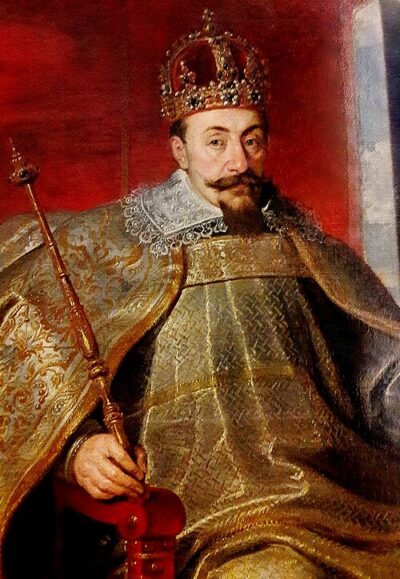
Sigismund III Vasa
Sigismund III Vasa was a King of Poland, Grand Duke of Lithuania and king of the Polish–Lithuanian Commonwealth from 1587 until 1632 and King of Sweden from 1592 until 1599. Born June 20, 1566, in Gripsholm Castle. Died April 19, 1632, in Warsaw. Positions held include King of Poland (1587–1632), Monarch of Sweden (1592–1599) and Grand Duke of Lithuania. Awards include Knight of the Order of the Golden Fleece.
Facts
30 facts · 1 confirmed by two sources · 3 cited · 25 from one source · 1 where the sources disagree
What’s different
- Died: we show April 19, 1632 (Sources disagree). Wikipedia says April 30, 1632
Where this comes from
Papalocal keeps its own record. It started from these sources; what each one said is kept here as it was copied, so a change on their side never changes this page by itself. Tap one to read its version.
What Wikidata says · copied November 16, 2026 · revision 2569004922
- Described as
- King of Poland, Grand Duke of Lithuania and king of the Polish–Lithuanian Commonwealth from 1587 until 1632 and King of Sweden from 1592 until 1599 (1566–1632)
- Other names
- Sigismund III of Poland
- Born
- June 20, 1566 · 13 references
- Died
- April 19, 1632 · 1 reference
- Born in
- Gripsholm Castle · 1 reference
- Died in
- Warsaw · 3 references
- Buried in
- Royal Tombs of the Wawel Cathedral
- Cause of death
- stroke
- Citizen of
- Polish–Lithuanian Commonwealth
- Occupation
- patron of the arts · 1 reference; monarch
- Positions held
- King of Poland (1587–1632); Monarch of Sweden (1592–1599); Grand Duke of Lithuania
- Instrument
- harpsichord · 1 reference
- Awards
- Knight of the Order of the Golden Fleece
- Spouse
- Anne of Austria, Queen of Poland (1592–) · 2 references; Constance of Austria (1605–) · 2 references
- Children
- Władysław IV Vasa · 1 reference; John II Casimir Vasa; John Albert Vasa; Karol Ferdynand Vasa; Alexander Charles Vasa; Anna Catherine Constance Vasa; Anna Maria Vasa
- Father
- John III of Sweden · 1 reference
- Mother
- Catherine Jagellon · 1 reference
- Siblings
- John, Duke of Östergötland; Isabella Johansdotter; Princess Anna of Sweden; Sofia Johansdotter (Gyllenhielm)
- Religion
- Catholicism
- Wikipedias with a page
- 71
Wikidata item Q52940 (wikidata.org/wiki/Q52940), public domain (CC0). Copied November 16, 2026.
What Wikipedia says · copied November 16, 2026 · revision 1385915090
Sigismund III Vasa (Polish: Zygmunt III Waza, Lithuanian: Žygimantas Vaza; 20 June 1566 – 30 April 1632
N.S.) was King of Poland and Grand Duke of Lithuania from 1587 to 1632 and, as Sigismund, King of Sweden from 1592 to 1599. He was the first Polish sovereign from the House of Vasa. Zealously religious, he imposed Catholicism across the vast realm, and his crusades against neighbouring states marked Poland's largest territorial expansion. A deeply polarising ruler, he presided over the end of the Golden Age of prosperity and achievement, further distinguished by the transfer of the country's capital from Kraków to Warsaw.
Sigismund was the son of King John III of Sweden and his first wife, Catherine Jagiellon, daughter of King Sigismund I of Poland. Elected monarch of the Polish–Lithuanian Commonwealth in 1587, he sought to unify Poland and Sweden under one Catholic kingdom, and when he succeeded his deceased father in 1592, the Polish–Swedish union was created. Opposition in Protestant Sweden caused a war against Sigismund headed by Sigismund's uncle Charles IX of Sweden, who deposed him in 1599.
Sigismund attempted to hold absolute power in all his dominions and frequently undermined parliament. He suppressed internal opposition, strengthened Catholic influence and granted privileges to the Jesuits, whom he employed as advisors and spies during the Counter-Reformation. He actively interfered in the affairs of neighbouring countries; his successful invasion of Russia during the Time of Troubles resulted in the seizure of Smolensk and occupation of Moscow, resulting in Poland's historical greatest territorial extent. Sigismund's army also defeated the Ottoman forces in southeastern Europe, which hastened the downfall of Sultan Osman II. However, the Polish–Swedish conflict had a less favourable outcome. After a series of skirmishes ending in a truce, King Gustavus Adolphus of Sweden launched a campaign against the Commonwealth and annexed parts of Polish Livonia.
Sigismund to this day remains a controversial figure in Poland. One of the country's most recognisable monarchs, his long reign partially coincided with the Polish Golden Age, the apex in the prestige, power and economic influence of the Polish–Lithuanian Commonwealth. On the other hand, it was also during his rule that the seeds of decline surfaced. Considerable contributions to the arts and architecture, as well as military victories, were tarnished by intrigues, religious conflicts and giving up Ducal Prussia to the elector of Brandenburg. He was commemorated in Warsaw by Sigismund's Column, one of the city's chief landmarks and the first secular monument in the form of a column in modern history. It was commissioned after Sigismund's death by his son and successor, Władysław IV Vasa.
- Born, in its opening lines
- June 20, 1566
- Died, in its opening lines
- April 30, 1632
From the Wikipedia article “Sigismund III Vasa” (en.wikipedia.org/wiki/Sigismund_III_Vasa), by its contributors, under CC BY-SA 4.0 (creativecommons.org/licenses/by-sa/4.0/). Copied November 16, 2026; not changed.
Confirmed Two sources agree. Cited One source, and it names where it got it. One source One source, without a reference of its own. Sources disagree The sources disagree. We show the best-supported value and keep theirs below.
