
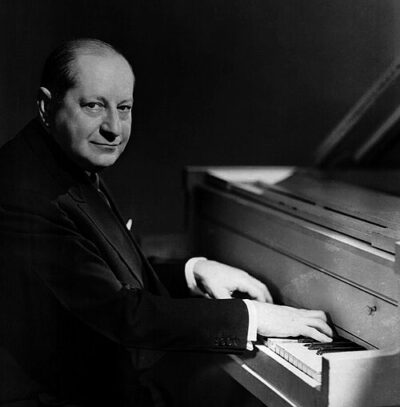
Sigmund Romberg
Sigmund Romberg was a Hungarian-born American composer. Born July 29, 1887, in Nagykanizsa. Died November 9, 1951, in New York City. Known for The Desert Song.
Facts
15 facts · 2 confirmed by two sources · 4 cited · 9 from one source
Where this comes from
Papalocal keeps its own record. It started from these sources; what each one said is kept here as it was copied, so a change on their side never changes this page by itself. Tap one to read its version.
What Wikidata says · copied November 16, 2026 · revision 2558236334
- Described as
- Hungarian-born American composer (1887–1951)
- Other names
- Siegmund Rosenberg
- Born
- July 29, 1887 · 9 references
- Died
- November 9, 1951 · 9 references
- Born in
- Nagykanizsa · 1 reference
- Died in
- New York City · 1 reference
- Buried in
- Ferncliff Cemetery · 1 reference
- Name at birth
- Siegmund Rosenberg
- Citizen of
- Austria–Hungary; United States
- Occupation
- pianist; composer · 2 references; screenwriter; film score composer
- Genre
- operetta
- Instrument
- piano
- Known for
- The Desert Song
- Wikipedias with a page
- 22
Wikidata item Q742945 (wikidata.org/wiki/Q742945), public domain (CC0). Copied November 16, 2026.
What Wikipedia says · copied November 16, 2026 · revision 1364430964
Sigmund Romberg (July 29, 1887 – November 9, 1951) was a Hungarian-born American composer. He is best known for his musicals and operettas, particularly The Student Prince (1924), The Desert Song (1926) and The New Moon (1928).
Early in his career, Romberg was employed by the Shubert brothers to write music for their musicals and revues, including several vehicles for Al Jolson. For the Shuberts, he also adapted several European operettas for American audiences, including the successful Maytime (1917) and Blossom Time (1921). His three hit operettas of the mid-1920s, named above, are in the style of Viennese operetta, but his other works from that time mostly employ the style of American musicals of their eras. He also composed film scores.
- Born, in its opening lines
- July 29, 1887
- Died, in its opening lines
- November 9, 1951
From the Wikipedia article “Sigmund Romberg” (en.wikipedia.org/wiki/Sigmund_Romberg), by its contributors, under CC BY-SA 4.0 (creativecommons.org/licenses/by-sa/4.0/). Copied November 16, 2026; not changed.
Confirmed Two sources agree. Cited One source, and it names where it got it. One source One source, without a reference of its own. Sources disagree The sources disagree. We show the best-supported value and keep theirs below.
