
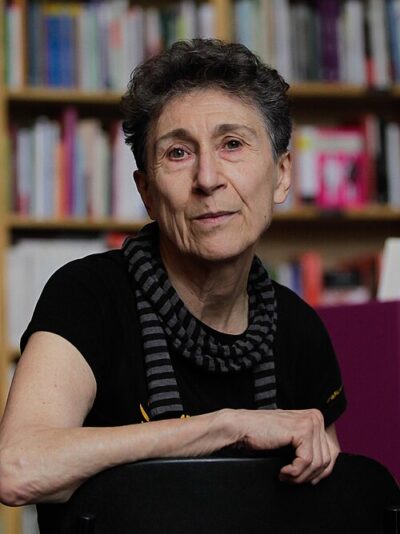
Silvia Federici
Silvia Federici is an Italian American scholar, teacher, and feminist activist. Born April 24, 1942, in Parma. Known for Caliban and the Witch. Educated at University at Buffalo and University of Bologna.
Facts
22 facts · 1 confirmed by two sources · 11 cited · 10 from one source
What’s different
- Born: we show April 24, 1942 (Confirmed). Wikidata also lists April 20, 1942
Where this comes from
Papalocal keeps its own record. It started from these sources; what each one said is kept here as it was copied, so a change on their side never changes this page by itself. Tap one to read its version.
What Wikidata says · copied November 15, 2026 · revision 2548709116
- Described as
- Italian American scholar, teacher, and feminist activist
- Born
- April 24, 1942 · 1 reference; April 20, 1942 · 2 references
- Born in
- Parma · 2 references
- Citizen of
- United States; Italy · 1 reference
- Occupation
- philosopher; writer; university teacher · 2 references; women's rights activist · 1 reference; activist · 1 reference; social scientist · 2 references; author · 2 references
- Worked for
- Hofstra University
- Education
- University at Buffalo; University of Bologna
- Known for
- Caliban and the Witch
- Field
- sociology; gender studies; political philosophy · 1 reference; social science · 1 reference; philosophy · 1 reference; feminism · 1 reference
- Spouse
- George Caffentzis · 1 reference
- Wikipedias with a page
- 38
Wikidata item Q597248 (wikidata.org/wiki/Q597248), public domain (CC0). Copied November 15, 2026.
What Wikipedia says · copied November 15, 2026 · revision 1382500287
Silvia Federici (Italian pronunciation: [ˈsilvja fedeˈriːtʃi]; born April 1942) is an Italian-American scholar, teacher, and Marxist feminist activist based in New York. She is considered one of the leading theoreticians in Marxist feminist theory, women's history, political philosophy, and the history and theory of the commons. Her most famous book, Caliban and the Witch (2004), has been translated into numerous languages and adopted in college courses.
For several decades, she has worked with a variety of international feminist organizations, such as Women in Nigeria (WIN) and the Latin American-based Ni una menos, to combat gender-based violence. In the 2010s, she organized a project with feminist collectives in Spain to reconstruct the history of women persecuted as witches in early modern Europe, and to raise awareness about what she believes are contemporary witch-hunts still taking place around the world.
- Born, in its opening lines
- April 1942
From the Wikipedia article “Silvia Federici” (en.wikipedia.org/wiki/Silvia_Federici), by its contributors, under CC BY-SA 4.0 (creativecommons.org/licenses/by-sa/4.0/). Copied November 15, 2026; not changed.
Confirmed Two sources agree. Cited One source, and it names where it got it. One source One source, without a reference of its own. Sources disagree The sources disagree. We show the best-supported value and keep theirs below.
