
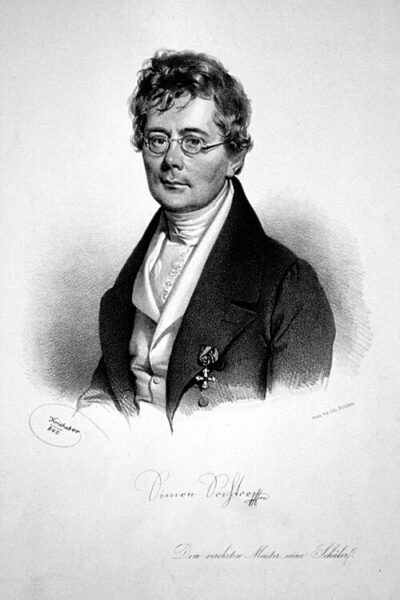
Simon Sechter was an Austrian composer. Born October 11, 1788, in Frymburk. Died September 10, 1867, in Vienna.
Facts
19 facts · 2 confirmed by two sources · 5 cited · 12 from one source
Where this comes from
Papalocal keeps its own record. It started from these sources; what each one said is kept here as it was copied, so a change on their side never changes this page by itself. Tap one to read its version.
What Wikidata says · copied November 18, 2026 · revision 2563983973
- Described as
- Austrian composer
- Born
- October 11, 1788 · 7 references
- Died
- September 10, 1867 · 9 references
- Born in
- Frymburk · 1 reference
- Died in
- Vienna · 2 references
- Buried in
- Vienna Central Cemetery
- Citizen of
- Austrian Empire · 1 reference
- Occupation
- composer · 3 references; conductor; musicologist · 1 reference; pedagogue; music educator; music theorist; university teacher; pianist
- Worked for
- University of Music and Performing Arts Vienna
- Genre
- opera
- Instrument
- piano; organ
- Lived in
- Kleine Sperlgasse 10 · 1 reference
- Wikipedias with a page
- 21
Wikidata item Q582713 (wikidata.org/wiki/Q582713), public domain (CC0). Copied November 18, 2026.
What Wikipedia says · copied November 18, 2026 · revision 1370776114
Simon Sechter (11 October 1788 – 10 September 1867) was an Austrian music theorist, composer, conductor, and organist. He is best known as a strict music teacher, whose many students included Anton Bruckner, Sigismond Thalberg, and Henri Vieuxtemps. In 1851, he was professor of composition at the Vienna Conservatory; after Sechter's death, his student Bruckner would succeed him and continue teaching his approach to harmony and counterpoint.
A highly prolific composer, his total output numbers more than 8,000 compositions, particularly since he sought to write a fugue every day. However, Sechter's best known works are his later (post-1825) masses and oratorios. Carl Christian Müller (1831–1914) compiled and adapted Sechter's Die richtige Folge der Grundharmonien as The Correct Order of Fundamental Harmonies: A Treatise on Fundamental Basses, and their Inversions and Substitutes (Wm. A. Pond, 1871; G. Schirmer, 1898).
- Born, in its opening lines
- October 11, 1788
- Died, in its opening lines
- September 10, 1867
From the Wikipedia article “Simon Sechter” (en.wikipedia.org/wiki/Simon_Sechter), by its contributors, under CC BY-SA 4.0 (creativecommons.org/licenses/by-sa/4.0/). Copied November 18, 2026; not changed.
Confirmed Two sources agree. Cited One source, and it names where it got it. One source One source, without a reference of its own. Sources disagree The sources disagree. We show the best-supported value and keep theirs below.
