
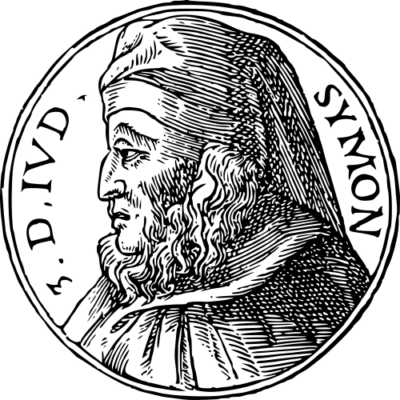
Simon Thassi
Simon Thassi was a second son of Mattathias, the first prince (r. 141–135 BCE) of the Hasmonean dynasty of the Kingdom of Judea. Born 2nd century BC. Died 135 BC, in Jericho. Positions held include High Priest of Israel (-143–-134).
Facts
16 facts · 0 confirmed by two sources · 3 cited · 13 from one source
Where this comes from
Papalocal keeps its own record. It started from these sources; what each one said is kept here as it was copied, so a change on their side never changes this page by itself. Tap one to read its version.
What Wikidata says · copied November 16, 2026 · revision 2565546545
- Described as
- second son of Mattathias, the first prince (r. 141–135 BCE) of the Hasmonean dynasty of the Kingdom of Judea
- Other names
- Simon Maccabaeus, Simon Maccabeus, Simon Maccabee, Shimeʻon ha-Tasi, Šīməʿōn ha-Tassī
- Born
- 2nd century BC
- Died
- 135 BC
- Died in
- Jericho · 1 reference
- Buried in
- Modiin
- Citizen of
- Hasmonean Judea
- Occupation
- military leader; priest
- Positions held
- High Priest of Israel (-143–-134)
- Children
- John Hyrcanus; Judas
- Father
- Mattathias · 1 reference
- Siblings
- Judah Maccabee · 1 reference; Jonathan Apphus · 1 reference; John Gaddi; Eleazar Avaran
- Religion
- Judaism
- Wikipedias with a page
- 36
Wikidata item Q359711 (wikidata.org/wiki/Q359711), public domain (CC0). Copied November 16, 2026.
What Wikipedia says · copied November 16, 2026 · revision 1377495578
Simon Thassi (Hebrew: שִׁמְעוֹן הַתַּסִּי Šīməʿōn haTassī; died 135 BC) was a Jewish leader of the Hasmonean dynasty, serving as high priest, military commander, and ruler of Judea. The second son of the Hasmonean patriarch Mattathias and one of the Maccabean brothers, he assumed leadership after his brother Jonathan Apphus was captured by the Seleucid general Diodotus Tryphon. Simon played a central role in consolidating Hasmonean rule: he strengthened Judea's fortifications, expelled the Seleucid garrison from Jerusalem, and expanded Jewish settlement, laying the foundation for the Hasmonean state. His rule marked the beginning of effective Jewish independence.
Simon assumed leadership in 143 BCE, completing Jerusalem's fortifications and securing key areas, including Gezer and the port city of Jaffa, where he stationed Jewish garrisons and settled Jewish inhabitants. He defended Judea from Tryphon's forces and recovered his brother Jonathan’s body for burial at Modi'in. Simon consolidated Judea's independence, cultivated relations with Rome, Sparta, and the Seleucid Empire, and was granted rights such as tax exemption and coinage, though he may not have used them. In 142/141 BCE, he captured the Acra fortress in Jerusalem, removing the last remaining Hellenistic presence in the city. A public assembly formalized his rule as high priest, military commander, and national leader of the Jews, with hereditary succession in his family "until a new prophet should arise."
Simon was assassinated in 134 BCE at the fortress of Dok near Jericho by his son-in-law Ptolemy ben Abubus. His third son, John Hyrcanus, escaped and succeeded him, continuing the Hasmonean dynasty and expanding Judea's borders.
From the Wikipedia article “Simon Thassi” (en.wikipedia.org/wiki/Simon_Thassi), by its contributors, under CC BY-SA 4.0 (creativecommons.org/licenses/by-sa/4.0/). Copied November 16, 2026; not changed.
Confirmed Two sources agree. Cited One source, and it names where it got it. One source One source, without a reference of its own. Sources disagree The sources disagree. We show the best-supported value and keep theirs below.
