
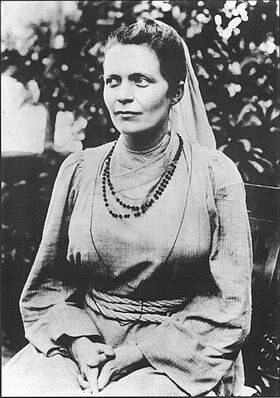
Sister Nivedita
Sister Nivedita was a Scots-Irish social worker, author, teacher and disciple of Swami Vivekananda. Born October 28, 1867, in County Tyrone. Died October 13, 1911, in Darjeeling. Known for Kali the Mother.
Facts
17 facts · 2 confirmed by two sources · 7 cited · 8 from one source
Where this comes from
Papalocal keeps its own record. It started from these sources; what each one said is kept here as it was copied, so a change on their side never changes this page by itself. Tap one to read its version.
What Wikidata says · copied November 16, 2026 · revision 2554669318
- Described as
- Scots-Irish social worker, author, teacher and disciple of Swami Vivekananda
- Other names
- Margaret Elizabeth Noble
- Born
- October 28, 1867 · 2 references
- Died
- October 13, 1911 · 2 references
- Born in
- County Tyrone · 1 reference
- Died in
- Darjeeling · 1 reference
- Name at birth
- Margaret Elizabeth Noble
- Citizen of
- United Kingdom of Great Britain and Ireland
- Occupation
- writer; social worker · 1 reference; teacher; priest · 1 reference; travel writer
- Known for
- Kali the Mother
- Field
- pedagogy · 1 reference; progressive education · 1 reference; social work · 1 reference; new education movement · 1 reference
- Religion
- Hinduism
- Wikipedias with a page
- 45
Wikidata item Q2353846 (wikidata.org/wiki/Q2353846), public domain (CC0). Copied November 16, 2026.
What Wikipedia says · copied November 16, 2026 · revision 1378466956
Sister Nivedita (Bengali pronunciation: [bhagini nibedita] ; née Margaret Elizabeth Noble; 28 October 1867 – 13 October 1911) was an Irish–Indian philosopher, educator, writer, social activist and disciple of Swami Vivekananda.
Sister Nivedita met Swami Vivekananda in 1895 in London and travelled to Calcutta (present-day Kolkata), India, in 1898. Swami Vivekananda gave her the name Nivedita (meaning "Dedicated to God") when he initiated her into the vow of Brahmacharya on 25 March 1898. In November 1898, she opened a girls' school in the Bagbazar area of North Calcutta. She wanted to educate girls who were deprived of even basic education. During the plague epidemic in Calcutta in 1899, Nivedita nursed and took care of the poor patients.
Nivedita had close associations with the newly established Ramakrishna Mission. Because of her active contribution in the field of Indian nationalism, she had to publicly dissociate herself from the activities of the Ramakrishna Mission under the then president, Swami Brahmananda. This had to be done in order to avoid their persecution at the hands of British authorities in India. She was very close to Sarada Devi, the wife of Ramakrishna and one of the major influences behind Ramakrishna Mission, and also with all brother disciples of Swami Vivekananda. She died on 13 October 1911 in Darjeeling. Her epitaph reads, "Here lies Sister Nivedita who gave her all to India."
- Born, in its opening lines
- October 28, 1867
- Died, in its opening lines
- October 13, 1911
From the Wikipedia article “Sister Nivedita” (en.wikipedia.org/wiki/Sister_Nivedita), by its contributors, under CC BY-SA 4.0 (creativecommons.org/licenses/by-sa/4.0/). Copied November 16, 2026; not changed.
Confirmed Two sources agree. Cited One source, and it names where it got it. One source One source, without a reference of its own. Sources disagree The sources disagree. We show the best-supported value and keep theirs below.
