
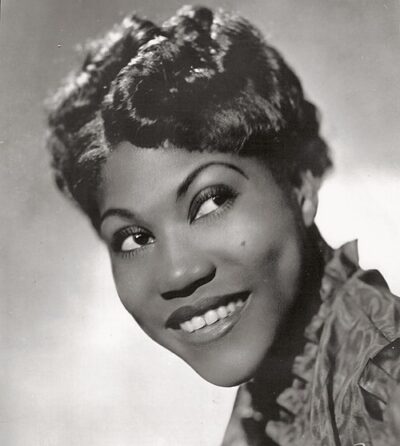
Sister Rosetta Tharpe
Sister Rosetta Tharpe was an American gospel musician. Born March 20, 1915, in Cotton Plant. Died October 9, 1973, in Philadelphia. Awards include Rock and Roll Hall of Fame, Arkansas Black Hall of Fame and Arkansas Entertainers Hall of Fame.
Facts
28 facts · 2 confirmed by two sources · 9 cited · 17 from one source
Where this comes from
Papalocal keeps its own record. It started from these sources; what each one said is kept here as it was copied, so a change on their side never changes this page by itself. Tap one to read its version.
What Wikidata says · copied November 15, 2026 · revision 2545592463
- Described as
- American gospel musician (1915–1973)
- Other names
- Rosetta Nubin, Rosetta Tharpe, Rosetta Nubin Tharpe
- Born
- March 20, 1915 · 4 references
- Died
- October 9, 1973 · 4 references
- Born in
- Cotton Plant · 1 reference
- Died in
- Philadelphia · 1 reference
- Buried in
- Northwood Cemetery · 1 reference
- Cause of death
- stroke
- Citizen of
- United States
- Occupation
- musician; singer; guitarist · 1 reference; jazz guitarist · 1 reference; gospel singer · 2 references
- Genre
- blues; gospel music; rhythm and blues; jazz; rock and roll
- Instrument
- guitar; electric guitar; voice
- Record label
- Decca
- Awards
- Rock and Roll Hall of Fame (2018) · 1 reference; Arkansas Black Hall of Fame (2012) · 1 reference; Arkansas Entertainers Hall of Fame (2013) · 1 reference; Arkansas Women's Hall of Fame (2022) · 1 reference
- Field
- musician
- Lived in
- Chicago (–1938); New York City
- Wikipedias with a page
- 34
Wikidata item Q438106 (wikidata.org/wiki/Q438106), public domain (CC0). Copied November 15, 2026.
What Wikipedia says · copied November 15, 2026 · revision 1381374851
Sister Rosetta Tharpe (born Rosetta Nubin, March 20, 1915 – October 9, 1973) was an American singer, songwriter, and guitarist. She gained popularity in the 1930s and 1940s with her gospel recordings, characterized by a unique mixture of spiritual lyrics and electric guitar. She was rooted in a pentecostal church and became the first great recording star of gospel music, and was among the first gospel musicians to appeal to rhythm and blues and rock and roll audiences, later being referred to as "the original soul sister" and "the Godmother of Rock and Roll". She influenced early rock-and-roll musicians, including Tina Turner, Little Richard, Chuck Berry, Johnny Cash, Carl Perkins, Elvis Presley, and Jerry Lee Lewis.
Tharpe is among the first Chicago blues musicians to play the electric guitar. Her guitar-playing technique had a profound influence on the development of British blues in the 1960s. Her European tour with Muddy Waters in 1964, with a stop in Manchester on May 7, is cited as important by British guitarists such as Eric Clapton, Jeff Beck, and Keith Richards.
Willing to cross the line between sacred and secular by performing her music of "light" in the "darkness" of nightclubs and concert halls with big bands behind her, Tharpe pushed spiritual music into the mainstream and helped pioneer the rise of pop-gospel, beginning in 1938 with the recording "Rock Me" and with her 1939 hit "This Train". Her unique music left a lasting mark on more conventional gospel artists such as Ira Tucker, Sr., of the Dixie Hummingbirds. While controversial among conservative religious groups due to her forays into the pop world, she never left gospel music.
Tharpe's 1944 release "Down by the Riverside" was selected for the National Recording Registry of the U.S. Library of Congress in 2004, which noted that it "captures her spirited guitar playing and unique vocal style, demonstrating clearly her influence on early rhythm-and-blues performers" and cited her influence on "many gospel, jazz, and rock artists". ("Down by the Riverside" was recorded by Tharpe on December 2, 1948, in New York City, and issued as Decca single #48106.) Her 1945 hit "Strange Things Happening Every Day", recorded in late 1944, featured Tharpe's vocals and guitar, with Sammy Price (piano), bass and drums. It was the first gospel record to cross over, hitting No. 2 on the Billboard "race records" chart, the term then used for what later became the R&B chart, in April 1945. The recording has been cited as a precursor of rock and roll, and alternatively has been called the first rock and roll record. In May 2018, Tharpe was posthumously inducted into the Rock and Roll Hall of Fame as an Early Influence.
- Born, in its opening lines
- March 20, 1915
- Died, in its opening lines
- October 9, 1973
From the Wikipedia article “Sister Rosetta Tharpe” (en.wikipedia.org/wiki/Sister_Rosetta_Tharpe), by its contributors, under CC BY-SA 4.0 (creativecommons.org/licenses/by-sa/4.0/). Copied November 15, 2026; not changed.
Confirmed Two sources agree. Cited One source, and it names where it got it. One source One source, without a reference of its own. Sources disagree The sources disagree. We show the best-supported value and keep theirs below.
