
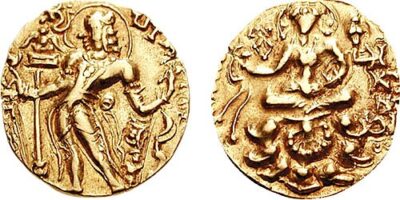
Skandagupta
Skandagupta was a Gupta Emperor. Born 5th century. Died 467. Positions held include Gupta emperor (455–467).
Facts
7 facts · 1 confirmed by two sources · 0 cited · 5 from one source · 1 where the sources disagree
What’s different
- Born: we show 5th century (Sources disagree). Wikipedia says 455
Where this comes from
Papalocal keeps its own record. It started from these sources; what each one said is kept here as it was copied, so a change on their side never changes this page by itself. Tap one to read its version.
What Wikidata says · copied November 16, 2026 · revision 2526811543
- Described as
- Gupta Emperor
- Born
- 5th century
- Died
- 467
- Citizen of
- Gupta Empire
- Occupation
- politician
- Positions held
- Gupta emperor (455–467)
- Father
- Kumaragupta I
- Siblings
- Purugupta
- Wikipedias with a page
- 31
Wikidata item Q1275876 (wikidata.org/wiki/Q1275876), public domain (CC0). Copied November 16, 2026.
What Wikipedia says · copied November 16, 2026 · revision 1376719227
Skandagupta (Ska-nda-gu-pta, r. c. 455–467) was a Gupta Emperor who ruled an empire centered on present-day northern India. His Bhitari pillar inscription suggests that he restored the Gupta power by defeating his enemies, who may have been rebels or foreign invaders. He repulsed an invasion by the Indo-Hephthalites (known as Hunas in India), probably the Kidarites. He seems to have maintained control of his inherited territory, and is generally considered the last of the great Gupta Emperors. The Gupta genealogy after him is unclear, but he was most probably succeeded by Purugupta, who appears to have been his younger half-brother.
- Born, in its opening lines
- 455
- Died, in its opening lines
- 467
From the Wikipedia article “Skandagupta” (en.wikipedia.org/wiki/Skandagupta), by its contributors, under CC BY-SA 4.0 (creativecommons.org/licenses/by-sa/4.0/). Copied November 16, 2026; not changed.
Confirmed Two sources agree. Cited One source, and it names where it got it. One source One source, without a reference of its own. Sources disagree The sources disagree. We show the best-supported value and keep theirs below.
