
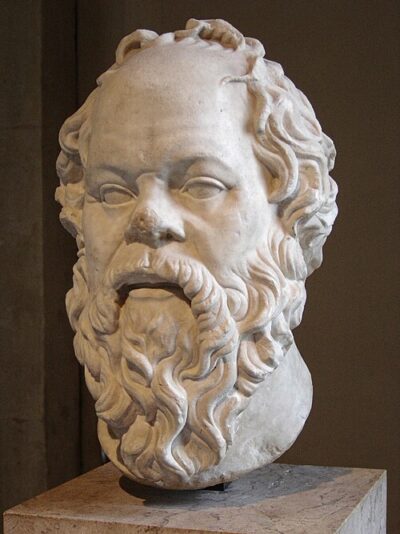
Socrates
Socrates was the 5th-century BCE Greek philosopher. Born 470 BC, in Athens. Died February 15, 399 BC, in Athens.
Facts
22 facts · 0 confirmed by two sources · 6 cited · 13 from one source · 3 where the sources disagree
What’s different
- Born: we show 470 BC (Sources disagree). Wikipedia says 470
- Died: we show February 15, 399 BC (Sources disagree). Wikidata also lists May 399 BC
- Born in: we show Athens (Sources disagree). Wikidata also lists Alopeke
Where this comes from
Papalocal keeps its own record. It started from these sources; what each one said is kept here as it was copied, so a change on their side never changes this page by itself. Tap one to read its version.
What Wikidata says · copied November 16, 2026 · revision 2568742134
- Described as
- 5th-century BCE Greek philosopher
- Other names
- Sokrates, Sokratis
- Born
- 470 BC · 1 reference
- Died
- February 15, 399 BC · 1 reference; May 399 BC · 1 reference
- Born in
- Alopeke; Athens · 1 reference
- Died in
- Athens
- Cause of death
- hemlock poisoning · 3 references
- Citizen of
- Classical Athens
- Occupation
- philosopher · 2 references; teacher · 1 reference; writer · 1 reference; ethicist · 1 reference
- Member of
- boule (-406–) · 1 reference
- Field
- philosophy; epistemology · 1 reference; ethics · 1 reference
- Spouse
- Xanthippe; Myrto
- Children
- Lamprocles; Menexenus
- Father
- Sophroniscus
- Mother
- Phaenarete
- Siblings
- Patrocles
- Lived in
- Classical Athens
- Wikipedias with a page
- 278
Wikidata item Q913 (wikidata.org/wiki/Q913), public domain (CC0). Copied November 16, 2026.
What Wikipedia says · copied November 16, 2026 · revision 1385239120
Socrates (; Ancient Greek: Σωκράτης, romanized: Sōkrátēs; c. 470 – 399 BC) was an ancient Greek philosopher from Classical Athens, perhaps the first Western moral philosopher, and a major inspiration on his student Plato, who largely founded the tradition of Western philosophy. An enigmatic figure, Socrates authored no texts and is known mainly through the posthumous accounts of classical writers, particularly his students Plato and Xenophon. These accounts are written as dialogues, in which Socrates and his interlocutors examine a subject in the style of question-and-answer; they gave rise to the Socratic dialogue literary genre. Contradictory accounts of Socrates make a reconstruction of his philosophy nearly impossible, a situation known as the Socratic problem. Socrates was a polarizing figure in Athenian society. In 399 BC, he was accused of impiety and corrupting the youth. After a trial that lasted a day, he was sentenced to death. As related by Plato, he was put to death by administration of poison (hemlock) after refusing offers from allies to help him escape.
Plato's dialogues are among the most comprehensive accounts of Socrates to survive from antiquity. They demonstrate the Socratic approach to areas of philosophy including epistemology and ethics. The Platonic Socrates lends his name to the concept of the Socratic method, and also to Socratic irony. The Socratic method of questioning, or elenchus, takes shape in dialogue using short questions and answers, epitomized by those Platonic texts in which Socrates and his interlocutors examine various aspects of an issue or an abstract meaning, usually relating to one of the virtues, and find themselves at an impasse, unable to define what they thought they understood. Socrates frequently proclaims his ignorance, saying that he is only sure that he does not know.
Socrates exerted a strong influence on philosophers in later antiquity and has continued to do so in the modern era. He was studied by medieval and Islamic scholars and played an important role in the thought of the Italian Renaissance, particularly within the humanist movement. Interest in him continued unabated, as reflected in the works of Søren Kierkegaard and Friedrich Nietzsche. Depictions of Socrates in art, literature, and popular culture have made him a widely known figure in the Western philosophical tradition.
- Born, in its opening lines
- 470
- Died, in its opening lines
- 399
From the Wikipedia article “Socrates” (en.wikipedia.org/wiki/Socrates), by its contributors, under CC BY-SA 4.0 (creativecommons.org/licenses/by-sa/4.0/). Copied November 16, 2026; not changed.
Confirmed Two sources agree. Cited One source, and it names where it got it. One source One source, without a reference of its own. Sources disagree The sources disagree. We show the best-supported value and keep theirs below.
