
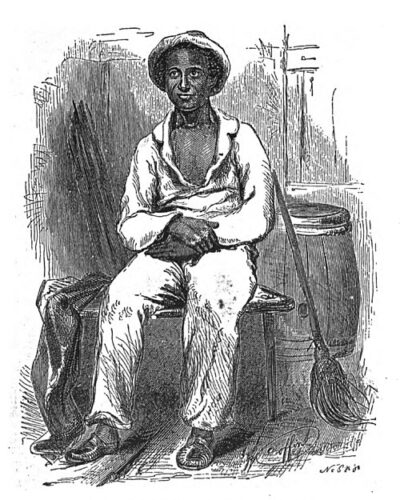
Solomon Northup
Solomon Northup was a free-born African American kidnapped by slave-traders. Born July 10, 1808, in Minerva. Died 1864.
Facts
10 facts · 0 confirmed by two sources · 4 cited · 6 from one source
Where this comes from
Papalocal keeps its own record. It started from these sources; what each one said is kept here as it was copied, so a change on their side never changes this page by itself. Tap one to read its version.
What Wikidata says · copied November 15, 2026 · revision 2570022569
- Described as
- free-born African American kidnapped by slave-traders
- Born
- July 10, 1808 · 1 reference
- Died
- 1864 · 8 references
- Born in
- Minerva · 1 reference
- Citizen of
- United States
- Occupation
- farmer; violinist; writer · 1 reference; abolitionist
- Instrument
- violin
- Father
- Mintus Northup
- Wikipedias with a page
- 32
Wikidata item Q3489578 (wikidata.org/wiki/Q3489578), public domain (CC0). Copied November 15, 2026.
What Wikipedia says · copied November 15, 2026 · revision 1380244151
Solomon Northup (July 10, c. 1807/1808 — unknown; after 1857) was an American abolitionist and the primary author of the memoir Twelve Years a Slave. A free-born American of mixed race from New York, he was the son of a freed slave and a free woman of color. Northup was a professional violinist, farmer, and landowner in Washington County, New York. In 1841, he was offered a traveling musician's job and went to Washington, D.C. (where slavery was legal); there, he was drugged and kidnapped into slavery. He was shipped to New Orleans on April 24, 1841 by James H. Birch aboard the Brig Orleans from Richmond, VA. Northup was purchased by a planter and held as a slave for nearly twelve years in the Red River region of Louisiana; mostly in Avoyelles Parish. He remained enslaved until he met Samuel Bass, a Canadian working on his plantation who helped get word to New York, where state law provided aid to free New York citizens who had been kidnapped and sold into slavery. His family and friends enlisted the aid of the governor of New York, Washington Hunt, and Northup regained his freedom on January 3, 1853.
The slave trader in Washington, D.C., James H. Birch, was arrested and tried, but acquitted because District of Columbia law at the time prohibited Northup as a black man from testifying against white people. Later, in New York State, his northern kidnappers were located and charged, but the case was tied up in court for two years because of jurisdictional challenges and finally dropped when Washington, D.C. was found to have jurisdiction. The D.C. government did not pursue the case. Those who had kidnapped and enslaved Northup received no punishment.
In his first year of freedom, Northup wrote and published a memoir, Twelve Years a Slave (1853). He lectured on behalf of the abolitionist movement, giving more than two dozen speeches throughout the Northeast about his experiences, to build momentum against slavery. He largely disappeared from the historical record after 1857, although a letter later reported him alive in early 1863. Some commentators thought he had been kidnapped again, but historians believe it unlikely, as he would have been considered too old to bring a good price. The details of his death have never been documented.
Northup's memoir was adapted and produced as the 1984 television film Solomon Northup's Odyssey and the 2013 feature film 12 Years a Slave. The latter won three Academy Awards, including Best Picture, at the 86th Academy Awards.
From the Wikipedia article “Solomon Northup” (en.wikipedia.org/wiki/Solomon_Northup), by its contributors, under CC BY-SA 4.0 (creativecommons.org/licenses/by-sa/4.0/). Copied November 15, 2026; not changed.
Confirmed Two sources agree. Cited One source, and it names where it got it. One source One source, without a reference of its own. Sources disagree The sources disagree. We show the best-supported value and keep theirs below.
