
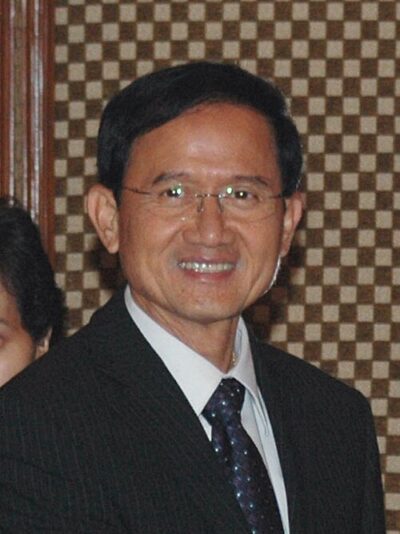
Somchai Wongsawat
Somchai Wongsawat is a prime minister of Thailand form september to december 2008. Born August 31, 1947, in Suan Khan. Positions held include Minister of Education of Thailand (2008), Prime Minister of Thailand (2008) and Minister of Defence of Thailand (2008). Educated at Amnuay Silpa School and Thammasat University. Awards include Grand Cordon of the Order of the White Elephant, Grand Cordon of the Order of the Crown of Thailand and Chakrabarti Mala Medal.
Facts
37 facts · 1 confirmed by two sources · 0 cited · 36 from one source
Where this comes from
Papalocal keeps its own record. It started from these sources; what each one said is kept here as it was copied, so a change on their side never changes this page by itself. Tap one to read its version.
What Wikidata says · copied November 16, 2026 · revision 2562805013
- Described as
- prime minister of Thailand form september to december 2008
- Born
- August 31, 1947
- Born in
- Suan Khan
- Citizen of
- Thailand
- Occupation
- politician; judge; executive; businessperson; civil servant
- Positions held
- Minister of Education of Thailand (2008); Prime Minister of Thailand (2008) · 1 reference; Minister of Defence of Thailand (2008); leader (2008) · 1 reference; Deputy Prime Minister of Thailand (2008) · 1 reference; Permanent Secretary of the Ministry of Justice (1999–2006) · 1 reference; Permanent Secretary of the Ministry of Labour (2006) · 1 reference; Member of the House of Representatives of Thailand (2007–2011) · 1 reference
- Political party
- People's Power Party (2007–2008); Pheu Thai Party (2021–2024); Pheu Tham Party (2017–2020)
- Education
- Amnuay Silpa School; Thammasat University; Thai Bar; National Defence College of Thailand
- Awards
- Grand Cordon of the Order of the White Elephant (1997); Grand Cordon of the Order of the Crown of Thailand (1992); Chakrabarti Mala Medal (1999); Boy Scout Citation Medal of Vajira (2008); Order of the Sun of Peru (2008)
- Field
- government
- Spouse
- Yaowapha Wongsawat (1978–) · 1 reference
- Children
- Yodchanan Wongsawat; Chinnicha Wongsawat; Chayapha Wongsawat
- Father
- Chem Wongsawat
- Mother
- Dap Wongsawat
- Religion
- Theravāda
- Lived in
- Phitsanulok Mansion (2008)
- Wikipedias with a page
- 38
Wikidata item Q298088 (wikidata.org/wiki/Q298088), public domain (CC0). Copied November 16, 2026.
What Wikipedia says · copied November 16, 2026 · revision 1384056777
Somchai Wongsawat (Thai: สมชาย วงศ์สวัสดิ์, pronounced [sǒm.tɕʰāːj wōŋ.sā.wàt] ; born 31 August 1947) is a Thai politician who served as the 26th prime minister of Thailand in 2008. He is a former executive member of the People's Power Party (PPP) whose political rights were disenfranchised by the Constitutional Court for five years.
Prior to entering electoral politics, he had served civil service and judicial service, having been appointed Permanent Secretary of Justice (the highest non-elected position in the civil service) in 2000 by the government of Chuan Leekpai. Following his retirement from office in 2006 owing to the pensionable age, he entered politics after the 2006 coup unseating the government of his brother-in-law, Thaksin Shinawatra. He joined the PPP which won the December 2007 parliamentary elections, becoming Minister of Education and Senior Deputy Prime Minister. After the premiership of Samak Sundaravej had been terminated by the Constitutional Court for contravening the conflict of interests law, Somchai was successfully nominated Prime Minister. His government had to deal with the 2008 Thailand political crisis as well as the 2008 financial crisis, and the PPP was eventually dissolved by the Constitutional Court and its executive members, including Somchai, were prohibited from politics for five years for vote-buying committed by Yongyuth Tiyapairat.
- Born, in its opening lines
- August 31, 1947
From the Wikipedia article “Somchai Wongsawat” (en.wikipedia.org/wiki/Somchai_Wongsawat), by its contributors, under CC BY-SA 4.0 (creativecommons.org/licenses/by-sa/4.0/). Copied November 16, 2026; not changed.
Confirmed Two sources agree. Cited One source, and it names where it got it. One source One source, without a reference of its own. Sources disagree The sources disagree. We show the best-supported value and keep theirs below.
