
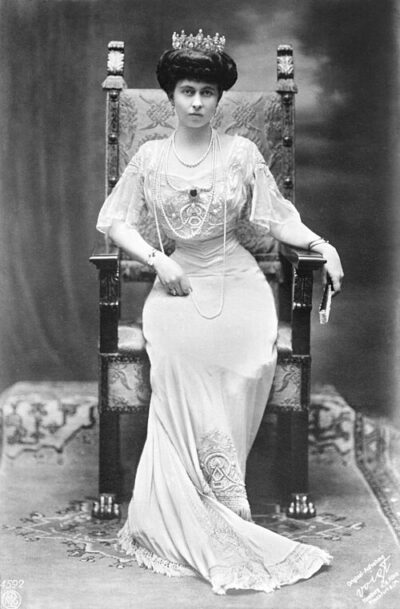
Sophia of Prussia
Sophia of Prussia was a Queen consort of Greece. Born June 14, 1870, in New Palace. Died January 13, 1932, in Frankfurt. Positions held include Queen consort of Greece (1913–). Awards include Decoration of the Royal Red Cross.
Facts
30 facts · 2 confirmed by two sources · 2 cited · 26 from one source
Where this comes from
Papalocal keeps its own record. It started from these sources; what each one said is kept here as it was copied, so a change on their side never changes this page by itself. Tap one to read its version.
What Wikidata says · copied November 16, 2026 · revision 2553830298
- Described as
- Queen consort of Greece (1870–1932)
- Other names
- Queen Sophia of Greece, Queen Sophia, Queen Consort of Greece
- Born
- June 14, 1870 · 3 references
- Died
- January 13, 1932 · 3 references
- Born in
- New Palace · 1 reference
- Died in
- Frankfurt · 1 reference
- Buried in
- Tatoi Royal Cemetery
- Cause of death
- cancer
- Citizen of
- Germany
- Occupation
- royalty
- Positions held
- Queen consort of Greece (1913–) · 1 reference
- Awards
- Decoration of the Royal Red Cross · 1 reference
- Spouse
- Constantine I of Greece (1889–1923) · 1 reference
- Children
- George II of Greece · 1 reference; Alexander of Greece; Helen of Greece and Denmark; Paul of Greece; Princess Irene, Duchess of Aosta; Princess Katherine of Greece and Denmark
- Father
- Frederick III, German Emperor
- Mother
- Victoria, Princess Royal
- Siblings
- Wilhelm II; Prince Sigismund of Prussia; Prince Waldemar of Prussia; Prince Henry of Prussia; Princess Charlotte of Prussia; Princess Viktoria of Prussia; Princess Margaret of Prussia
- Religion
- Eastern Orthodoxy
- Lived in
- New Palace; Kronprinzenpalais
- Nickname
- Sossy
- Wikipedias with a page
- 43
Wikidata item Q155822 (wikidata.org/wiki/Q155822), public domain (CC0). Copied November 16, 2026.
What Wikipedia says · copied November 16, 2026 · revision 1376810263
Sophia of Prussia (Sophie Dorothea Ulrike Alice, Greek: Σοφία Δωροθέα Ουλρίκη Αλίκη, romanized: Sofía Dorothéa Oulríki Alíki; 14 June 1870 – 13 January 1932) was Queen of Greece twice from 18 March 1913 to 11 June 1917 and again from 19 December 1920 to 27 September 1922 as the wife of King Constantine I of Greece.
A member of the House of Hohenzollern and child of Frederick III, German Emperor, Sophia received a liberal and Anglophile education, under the supervision of her mother Victoria, Princess Royal. In 1889, less than a year after the death of her father, she married her third cousin Constantine, heir apparent to the Greek throne. After a difficult period of adaptation in her new country, Sophia gave birth to six children and became involved in the assistance to the poor, following in the footsteps of her mother-in-law, Queen Olga. However, it was during the wars which Greece faced during the end of the 19th and the beginning of the 20th century that Sophia showed the most social activity: she founded field hospitals, oversaw the training of Greek nurses, and treated wounded soldiers.
However, Sophia was hardly rewarded for her actions, even after her grandmother Queen Victoria decorated her with the Royal Red Cross after the Thirty Days' War: the Greeks criticized her links with Germany. Her eldest brother, German Emperor Wilhelm II, was indeed an ally of the Ottoman Empire and openly opposed the construction of the Megali Idea, which could establish a Greek state that would encompass all ethnic Greek-inhabited areas. During World War I, the blood ties between Sophia and the Emperor also aroused the suspicion of the Triple Entente, which criticized Constantine I for his neutrality in the conflict.
After imposing a blockade of Greece and supporting the rebel government of Eleftherios Venizelos, causing the National Schism, France and its allies deposed Constantine in June 1917. Sophia and her family then went into exile in Switzerland. Sophia's second son, Alexander, replaced his father on the throne. At the same time, Greece entered the war alongside the Triple Entente, which allowed for impressive, but eventually temporary, territorial gains. After the outbreak of the Greco-Turkish War in 1919 and the untimely death of Alexander the following year, the Venizelists abandoned power, allowing the royal family to return to Athens. However, the defeat of the Greek army against the Turkish troops of Mustafa Kemal forced Constantine to abdicate in 1922, at which point his eldest son became King George II. Sophia and her family were then forced to a new exile, and settled in Italy, where Constantine died one year later, in 1923. With the proclamation of the Republic in Athens the following year, Sophia spent her last years alongside her family, before dying of cancer in Germany in 1932 at the age of 61.
- Born, in its opening lines
- June 14, 1870
- Died, in its opening lines
- January 13, 1932
From the Wikipedia article “Sophia of Prussia” (en.wikipedia.org/wiki/Sophia_of_Prussia), by its contributors, under CC BY-SA 4.0 (creativecommons.org/licenses/by-sa/4.0/). Copied November 16, 2026; not changed.
Confirmed Two sources agree. Cited One source, and it names where it got it. One source One source, without a reference of its own. Sources disagree The sources disagree. We show the best-supported value and keep theirs below.
