
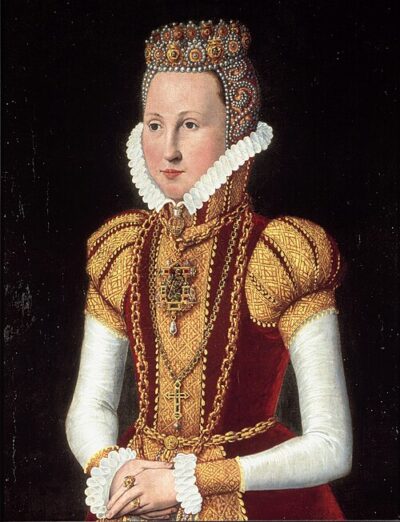
Sophie of Mecklenburg-Güstrow
Sophie of Mecklenburg-Güstrow was a Queen consort of Denmark and Norway. Born September 4, 1557, in Wismar. Died October 4, 1631, in Nykøbing Falster. Positions held include Queen consort of Denmark (1572–1588).
Facts
19 facts · 2 confirmed by two sources · 7 cited · 10 from one source
Where this comes from
Papalocal keeps its own record. It started from these sources; what each one said is kept here as it was copied, so a change on their side never changes this page by itself. Tap one to read its version.
What Wikidata says · copied November 16, 2026 · revision 2569133385
- Described as
- Queen consort of Denmark and Norway (1557-1631)
- Other names
- Queen Sophie
- Born
- September 4, 1557 · 1 reference
- Died
- October 4, 1631 · 1 reference
- Born in
- Wismar · 1 reference
- Died in
- Nykøbing Falster · 1 reference
- Buried in
- Roskilde Cathedral
- Citizen of
- Duchy of Mecklenburg
- Occupation
- consort
- Positions held
- Queen consort of Denmark (1572–1588)
- Spouse
- Frederick II of Denmark (1572–1588) · 2 references
- Children
- Elizabeth of Denmark, Duchess of Brunswick-Wolfenbüttel; Anne of Denmark · 1 reference; Christian IV of Denmark · 1 reference; Ulrik of Denmark; Augusta of Denmark · 1 reference; Hedwig of Denmark · 1 reference; John, Prince of Schleswig-Holstein
- Father
- Ulrich, Duke of Mecklenburg
- Mother
- Elizabeth of Denmark, Duchess of Mecklenburg
- Religion
- Lutheranism
- Wikipedias with a page
- 38
Wikidata item Q57654 (wikidata.org/wiki/Q57654), public domain (CC0). Copied November 16, 2026.
What Wikipedia says · copied November 16, 2026 · revision 1379187587
Sophie of Mecklenburg-Güstrow (Sophia; 4 September 1557 – 4 October 1631) was Queen of Denmark and Norway from 1572 to 1588 as the wife of Frederick II. She was the mother of Christian IV and Anne of Denmark, and served as regent of the duchies of Schleswig and Holstein from 1590 to 1594. Especially noted for her effective management of her extensive dower lands and a large credit operation, which made her one of the wealthiest landowners and financiers of her time, she was an influential political figure in Northern Europe.
The only child of Ulrich III of Mecklenburg-Güstrow and Elizabeth of Denmark, Sophie married her first cousin Frederick in 1572, aged fourteen. Their union is widely described as unusually affectionate for the period. As queen, she maintained her own household and patronages and pursued interests in natural philosophy, astrology, alchemy, chemistry and iatrochemistry. She supported scholars including Anders Vedel and Tycho Brahe, whom she visited on Ven in 1586 and later. She did not, however, exercise formal political power during the reign of her husband. Following Frederick’s death in 1588, Sophie sought to lead the regency for the underage Christian IV, bringing her into conflict with the Council of the Realm. Although she did not prevail in directing the royal regency, she was recognised by the Danish nobility and Emperor Rudolf II as regent in the duchies until 1594, after which she withdrew to her dower lands, consisting of Lolland and Falster. From there she continued to intervene in affairs of state through correspondence, credit, and marriage diplomacy, arranging advantageous Protestant alliances for her daughters and for Christian IV with the houses of Stuart, Welf (Brunswick-Lüneburg), Hohenzollern (Brandenburg), Holstein-Gottorp and Wettin (Saxony), often contributing substantial funds for jewellery and dowries herself.
As dowager, Sophie reorganised her dower estate's administration, undertook agrarian improvements, and operated an extensive lending business. By advancing large loans at interest, among others to Christian IV, James VI and I and several German princes, she secured influence over policy and wartime finance. Drawing on her "inexhaustible coffers", she provided financial support to the Danish–Norwegian realm, subsidising major royal initiatives in construction and warfare. By contemporary and modern accounts she amassed an extraordinary fortune, becoming the richest woman in Northern Europe and, by some assessments, the second-wealthiest individual in Europe after Maximilian I of Bavaria. At her death, James Howell, secretary to the English Ambassador in Denmark, described her as the "richest Queen in Christendom".
Sophie’s political role extended beyond finance. Through steady correspondence and mediation among Protestant courts, she influenced Danish foreign policy during the confessional conflicts of her son’s reign, participating in efforts to form a Protestant league, and conducting considerable diplomacy in the early phases of the Thirty Years’ War. Historians note that through these strategies she "[financed] diplomacy and war", and her efforts contributed to the diplomatic course leading to the Treaty of Lübeck (1629), which ended Denmark’s active participation in the conflict.
Earlier historiography often minimised or disparaged her agency, dismissing her as power-hungry and rapacious. However, some 19th-century writers, notably Ellen Jørgensen, praised her "unparalleled skill" and "indomitable resourcefulness". Recent scholarship reassesses her widowhood and emphasises her entrepreneurship and, in particular, her capacity to entrench herself as a pervasive force within the political landscape of late Reformation Denmark and northern Europe. She died at Nykøbing Castle in 1631 and was buried in Roskilde Cathedral.
- Born, in its opening lines
- September 4, 1557
- Died, in its opening lines
- October 4, 1631
From the Wikipedia article “Sophie of Mecklenburg-Güstrow” (en.wikipedia.org/wiki/Sophie_of_Mecklenburg-Güstrow), by its contributors, under CC BY-SA 4.0 (creativecommons.org/licenses/by-sa/4.0/). Copied November 16, 2026; not changed.
Confirmed Two sources agree. Cited One source, and it names where it got it. One source One source, without a reference of its own. Sources disagree The sources disagree. We show the best-supported value and keep theirs below.
