
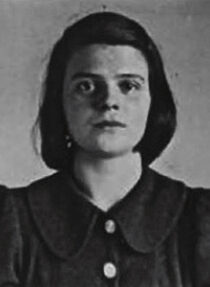
Sophie Scholl
Sophie Scholl was a German resistance fighter during the Nazi regime, member of the White Rose. Born May 9, 1921, in Forchtenberg. Died February 22, 1943, in Munich Prison. Educated at LMU Munich.
Facts
22 facts · 2 confirmed by two sources · 7 cited · 13 from one source
Where this comes from
Papalocal keeps its own record. It started from these sources; what each one said is kept here as it was copied, so a change on their side never changes this page by itself. Tap one to read its version.
What Wikidata says · copied November 16, 2026 · revision 2568741548
- Described as
- German resistance fighter during the Nazi regime, member of the White Rose (1921-1943)
- Other names
- Sophia Magdalena Scholl, Sofie Scholl, Sophia Magdalena Sophie Scholl
- Born
- May 9, 1921 · 7 references
- Died
- February 22, 1943 · 5 references
- Born in
- Forchtenberg · 1 reference
- Died in
- Munich Prison · 1 reference
- Buried in
- Perlacher Forst Cemetery · 1 reference
- Cause of death
- decapitation · 1 reference
- Name at birth
- Sophia Magdalena Scholl
- Citizen of
- German Reich
- Occupation
- university student; resistance fighter · 2 references; student · 1 reference
- Education
- LMU Munich
- Member of
- White Rose · 1 reference; League of German Girls · 1 reference; Hans and Sophie Scholl · 1 reference
- Father
- Robert Scholl · 1 reference
- Mother
- Magdalena Scholl · 2 references
- Siblings
- Inge Scholl · 1 reference; Werner Scholl; Hans Scholl · 2 references; Elisabeth Hartnagel · 1 reference
- Religion
- Lutheranism
- Wikipedias with a page
- 75
Wikidata item Q76972 (wikidata.org/wiki/Q76972), public domain (CC0). Copied November 16, 2026.
What Wikipedia says · copied November 16, 2026 · revision 1384643988
Sophia Magdalena Scholl (9 May 1921 – 22 February 1943) was a German student and anti-Nazi political activist, active in the White Rose non-violent resistance group in Nazi Germany.
Raised in a politically engaged family, Scholl initially joined the Bund Deutscher Mädel, the female branch of the Hitler Youth, but later became critical of the Nazi regime. Influenced by philosophy, theology, and the writings of Theodor Haecker, she became involved in passive resistance efforts alongside her brother, Hans, and fellow students. The White Rose distributed leaflets calling for opposition to the Nazi state, citing ethical and philosophical arguments against its policies. In February 1943, after being caught distributing leaflets at the Ludwig-Maximilians-Universität München, she and her brother Hans were arrested by the Gestapo, interrogated, and convicted of high treason in a show trial presided over by Roland Freisler. They were sentenced to death and executed by guillotine.
After her death, copies of the final White Rose leaflet were air-dropped over Germany by the Allies. In the decades following her death, numerous schools, streets, and memorials have been named in her and her brother's honor for their role in anti-Nazi resistance. Her story has been depicted in several films, books, and other media, including the Oscar nominated film Sophie Scholl – The Final Days.
- Born, in its opening lines
- May 9, 1921
- Died, in its opening lines
- February 22, 1943
From the Wikipedia article “Sophie Scholl” (en.wikipedia.org/wiki/Sophie_Scholl), by its contributors, under CC BY-SA 4.0 (creativecommons.org/licenses/by-sa/4.0/). Copied November 16, 2026; not changed.
Confirmed Two sources agree. Cited One source, and it names where it got it. One source One source, without a reference of its own. Sources disagree The sources disagree. We show the best-supported value and keep theirs below.
