
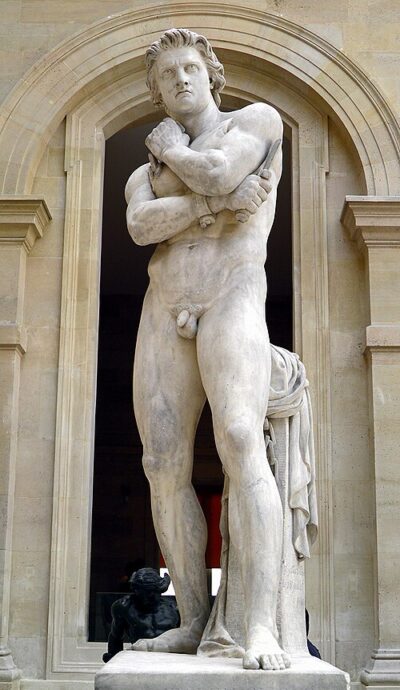
Spartacus
Spartacus was a Thracian gladiator who led a slave uprising against the Roman Republic. Born 103 BC, in Thrace. Died April 71 BC, in Lucania.
Facts
6 facts · 0 confirmed by two sources · 2 cited · 4 from one source
Where this comes from
Papalocal keeps its own record. It started from these sources; what each one said is kept here as it was copied, so a change on their side never changes this page by itself. Tap one to read its version.
What Wikidata says · copied November 16, 2026 · revision 2553820875
- Described as
- Thracian gladiator who led a slave uprising against the Roman Republic
- Other names
- Spártakos
- Born
- 103 BC
- Died
- April 71 BC · 1 reference
- Born in
- Thrace · 1 reference
- Died in
- Lucania
- Occupation
- gladiator; military leader
- Wikipedias with a page
- 92
Wikidata item Q83406 (wikidata.org/wiki/Q83406), public domain (CC0). Copied November 16, 2026.
What Wikipedia says · copied November 16, 2026 · revision 1382149172
Spartacus (; c. 103 – 71 BC) was a Thracian gladiator who was one of the escaped slave leaders in the Third Servile War, a major slave uprising against the Roman Republic.
Historical accounts of his life come primarily from Plutarch and Appian, who wrote more than a century after his death. Plutarch's Life of Crassus and Appian's Civil Wars provide the most detailed accounts of the slave revolt. Although Spartacus is a significant figure in Roman history, no contemporary sources exist, and all accounts are written significantly later, by persons not directly involved, and without perspectives of slaves or eyewitnesses. Little is known about him beyond the events of the war, and the extant accounts are contradictory. All sources agree, however, that he was a former gladiator and accomplished military leader.
Spartacus is described as having been born near the Strymon river, in Thrace (now known as Bulgaria), possibly from the Maedi tribe. Before his enslavement and use as a gladiator, he served as a soldier with the Romans. His revolt began in 73 BC when, along with about 70 other gladiators, he escaped a gladiatorial school near Capua. Despite their initially small numbers, Spartacus's forces were able to defeat several Roman military units and swell their ranks to an estimated 70,000 enslaved people and others. Spartacus proved himself a capable tactician despite the dearth of formal military training among his followers, who were a diverse mix.
The rebellion posed a significant challenge to Roman authority, prompting a series of military campaigns against it. Ultimately, Marcus Licinius Crassus was tasked with suppressing the revolt. Despite initial successes and attempts to negotiate and escape to Sicily, Spartacus's forces were defeated in 71 BC. Spartacus was presumed killed in the final battle, although his body was never found. In the aftermath of the rebellion, 6,000 captured rebels were crucified along the Appian Way.
Spartacus's motives remain a subject of debate. Some sources suggest he aimed to escape Italy, while others hint at broader social reform goals. His legacy has endured, inspiring cultural works and becoming a symbol of resistance and revolutionary movements. The rebellion, interpreted as an example of oppressed people fighting for their freedom against a slave-owning oligarchy, has been portrayed in literature, television, and film. The philosopher Voltaire described the Third Servile War as "the only just war in history". Although this interpretation is not specifically contradicted by classical historians, no historical account claims that the goal was to end slavery in the Republic.
From the Wikipedia article “Spartacus” (en.wikipedia.org/wiki/Spartacus), by its contributors, under CC BY-SA 4.0 (creativecommons.org/licenses/by-sa/4.0/). Copied November 16, 2026; not changed.
Confirmed Two sources agree. Cited One source, and it names where it got it. One source One source, without a reference of its own. Sources disagree The sources disagree. We show the best-supported value and keep theirs below.
