
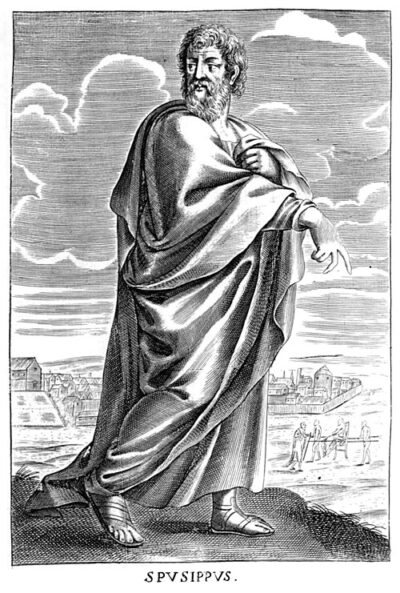
Speusippus
Speusippus was the 4th-century BC Greek philosopher. Born 407 BC, in Classical Athens. Died 339 BC. Positions held include scholarch of the Platonic Academy (-347–-339).
Facts
9 facts · 0 confirmed by two sources · 0 cited · 7 from one source · 2 where the sources disagree
What’s different
- Born: we show 407 BC (Sources disagree). Wikipedia says 408
- Died: we show 339 BC (Sources disagree). Wikipedia says 339
Where this comes from
Papalocal keeps its own record. It started from these sources; what each one said is kept here as it was copied, so a change on their side never changes this page by itself. Tap one to read its version.
What Wikidata says · copied November 16, 2026 · revision 2565598883
- Described as
- 4th-century BC Greek philosopher
- Born
- 407 BC
- Died
- 339 BC
- Born in
- Classical Athens
- Citizen of
- Classical Athens
- Occupation
- philosopher; mathematician
- Positions held
- scholarch of the Platonic Academy (-347–-339)
- Father
- Eurymedon of Myrrhinus · 1 reference
- Mother
- Potone · 1 reference
- Wikipedias with a page
- 37
Wikidata item Q325955 (wikidata.org/wiki/Q325955), public domain (CC0). Copied November 16, 2026.
What Wikipedia says · copied November 16, 2026 · revision 1383663565
Speusippus (; Ancient Greek: Σπεύσιππος; c. 408 – 339/8 BC) was an ancient Greek philosopher. Speusippus was Plato's nephew by his sister Potone. After Plato's death, c. 348 BC, Speusippus inherited the Academy, near age 60, and remained its head for the next eight years. However, following a stroke, he passed the chair to Xenocrates. Although the successor to Plato in the Academy, Speusippus frequently diverged from Plato's teachings. He rejected Plato's Theory of Forms, and whereas Plato had identified the Good with the ultimate principle, Speusippus maintained that the Good was merely secondary. He also argued that it is impossible to have satisfactory knowledge of any thing without knowing all the differences by which it is separated from everything else.
The standard edition of the surviving fragments and testimonies is Leonardo Tarán's Speusippus of Athens: A Critical Study with a Collection of the Related Texts and Commentary (1982).
- Born, in its opening lines
- 408
- Died, in its opening lines
- 339
From the Wikipedia article “Speusippus” (en.wikipedia.org/wiki/Speusippus), by its contributors, under CC BY-SA 4.0 (creativecommons.org/licenses/by-sa/4.0/). Copied November 16, 2026; not changed.
Confirmed Two sources agree. Cited One source, and it names where it got it. One source One source, without a reference of its own. Sources disagree The sources disagree. We show the best-supported value and keep theirs below.
