
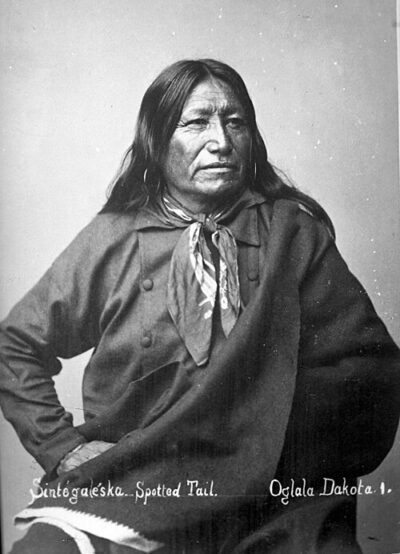
Spotted Tail
Spotted Tail was a Brulé Sioux chief, Native American leader. Born 1823, in South Dakota. Died August 5, 1881, in South Dakota. Positions held include traditional leader or chief.
Facts
9 facts · 2 confirmed by two sources · 1 cited · 6 from one source
What’s different
- Born: we show 1823 (Confirmed). Wikidata also lists 1833
Where this comes from
Papalocal keeps its own record. It started from these sources; what each one said is kept here as it was copied, so a change on their side never changes this page by itself. Tap one to read its version.
What Wikidata says · copied November 18, 2026 · revision 2553938888
- Described as
- Brulé Sioux chief, Native American leader (1823–1881)
- Other names
- Siŋté Glešká, Sinte Gleska
- Born
- 1823 · 1 reference; 1833
- Died
- August 5, 1881
- Born in
- South Dakota
- Died in
- South Dakota
- Buried in
- Spotted Tail Gravesite
- Cause of death
- gunshot wound · 1 reference
- Citizen of
- United States
- Occupation
- politician
- Positions held
- traditional leader or chief
- Wikipedias with a page
- 15
Wikidata item Q267752 (wikidata.org/wiki/Q267752), public domain (CC0). Copied November 18, 2026.
What Wikipedia says · copied November 18, 2026 · revision 1381966249
Spotted Tail (Siŋté Glešká, Lakota: [sɪ̃ˈtɛ ɡlɛʃˈka]; birth name Tȟatȟáŋka Napsíča [tˣaˈtˣə̃ka napˈsɪtʃa], 'Jumping Buffalo'; c. 1823 – August 5, 1881) was a Sichangu Lakota tribal chief. Famed as a great warrior since his youth, warring on Ute, Pawnee and Absaroke ('Crow'), and having taken a leading part in the Grattan Massacre, he led his warriors in the Colorado and Platte River uprising (Spotted Tail's War) after the massacre perpetrated by John M. Chivington's Colorado Volunteers on the peaceful Cheyenne and Arapaho camping on Sand Creek (November 29, 1864), but declined to participate in Red Cloud's War.
After spending almost two years as a prisoner in Fort Leavenworth following the Grattan affair, Spotted Tail was able to speak the English language well, and to deal with the "Wasichu" (white men) without an interpreter, whom he did not trust. He had become convinced of the futility of making war to oppose the white incursions into his homeland; he became a statesman, speaking for peace and defending the rights of his tribe by using his knowledge of “wasichu” language and system to increase his political capability to hinder their tricks and deceptions.
He made several trips to Washington, D.C. in the 1870s to represent his people, and was noted for his interest in bringing education to the Sioux. General Anson Mills, who knew Spotted Tail well, called him "a fine-looking man, with engaging manners, perfectly loyal to the government, a lover of peace, knowing no good could come to his people from war," a man who had both a high respect for and confidence in U.S. Army officers as well as a good sense of humor.
He was shot in the back and killed by Crow Dog, a Sichangu Lakota subchief, in 1881 for reasons which have been disputed.
- Born, in its opening lines
- c. 1823
- Died, in its opening lines
- August 5, 1881
From the Wikipedia article “Spotted Tail” (en.wikipedia.org/wiki/Spotted_Tail), by its contributors, under CC BY-SA 4.0 (creativecommons.org/licenses/by-sa/4.0/). Copied November 18, 2026; not changed.
Confirmed Two sources agree. Cited One source, and it names where it got it. One source One source, without a reference of its own. Sources disagree The sources disagree. We show the best-supported value and keep theirs below.
