
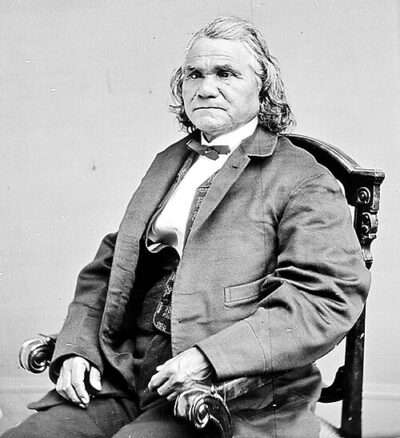
Stand Watie
Stand Watie was the 2nd principal chief of the Cherokee Nation. Born December 12, 1806, in Cherokee Nation. Died September 9, 1871, in Cherokee Nation. Positions held include Principal Chief of the Cherokee Nation (1862–1866).
Facts
16 facts · 2 confirmed by two sources · 3 cited · 11 from one source
Where this comes from
Papalocal keeps its own record. It started from these sources; what each one said is kept here as it was copied, so a change on their side never changes this page by itself. Tap one to read its version.
What Wikidata says · copied November 15, 2026 · revision 2553935852
- Described as
- 2nd principal chief of the Cherokee Nation
- Other names
- Ta ke au keh, Degadoga, Isaac S. Watie, Isaac Stand Watie, Degataga, Standhope Oowatie, Tahkatotah, Talkertalker
- Born
- December 12, 1806 · 3 references
- Died
- September 9, 1871 · 3 references
- Born in
- Cherokee Nation
- Died in
- Cherokee Nation
- Buried in
- Polson Cemetery · 1 reference
- Name at birth
- Degadoga · 1 reference
- Citizen of
- United States
- Occupation
- army officer; traditional leader or chief; politician · 1 reference
- Positions held
- Principal Chief of the Cherokee Nation (1862–1866) · 1 reference
- Siblings
- Elias Boudinot
- Military branch
- Provisional Army of the Confederate States (1861–1865)
- Military rank
- colonel (1861–1864) · 1 reference; brigadier general (1864–1865) · 1 reference; general · 1 reference
- Wikipedias with a page
- 25
Wikidata item Q288408 (wikidata.org/wiki/Q288408), public domain (CC0). Copied November 15, 2026.
What Wikipedia says · copied November 15, 2026 · revision 1381538996
Brigadier-General Stand Watie (Cherokee: ᏕᎦᏙᎦ, romanized: Degadaga, or Degadoga, lit. 'Stands on Two Feet'; December 12, 1806 – September 9, 1871), also known as Standhope Uwatie and Isaac S. Watie, was a Cherokee politician who served as the second principal chief of the Cherokee Nation from 1862 to 1866. The Cherokee Nation allied with the Confederate States during the American Civil War, and he was subsequently the only Native American Confederate general officer. Watie commanded Indian forces in the Trans-Mississippi Theater, made up mostly of Cherokee, Muskogee, and Seminole. He was the last Confederate States Army general to surrender.
Before removal of the Cherokee to Indian Territory in the late 1830s, Watie and his older brother Elias Boudinot were among Cherokee leaders who signed the Treaty of New Echota in 1835. The majority of the tribe opposed their action. In 1839, the brothers were attacked in an assassination attempt, as were other relatives active in the Treaty Party. All but Stand Watie were killed. Watie in 1842 killed one of his uncle's attackers, and in 1845 his brother Thomas was killed in retaliation, in a continuing cycle of violence that reached Indian Territory. Watie was acquitted by the Cherokee at trial in the 1850s on the grounds of self-defense.
Watie led the Southern Cherokee delegation to Washington, D.C., after the American Civil War to sue for peace, hoping to have tribal divisions recognized. The federal government negotiated only with the leaders who had sided with the Union. Watie stayed out of politics for his last years, and tried to rebuild his plantation.
- Born, in its opening lines
- December 12, 1806
- Died, in its opening lines
- September 9, 1871
From the Wikipedia article “Stand Watie” (en.wikipedia.org/wiki/Stand_Watie), by its contributors, under CC BY-SA 4.0 (creativecommons.org/licenses/by-sa/4.0/). Copied November 15, 2026; not changed.
Confirmed Two sources agree. Cited One source, and it names where it got it. One source One source, without a reference of its own. Sources disagree The sources disagree. We show the best-supported value and keep theirs below.
