
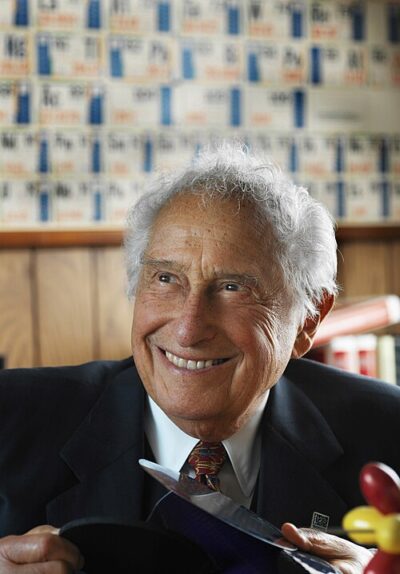
Stanford R. Ovshinsky
Stanford R. Ovshinsky was a prolific American inventor and scientist. Born November 24, 1922, in Akron. Died October 17, 2012, in Bloomfield Hills. Educated at Buchtel High School. Awards include Rudolf-Diesel-Medaille, National Inventors Hall of Fame and Fellow of the American Physical Society.
Facts
16 facts · 2 confirmed by two sources · 5 cited · 9 from one source
Where this comes from
Papalocal keeps its own record. It started from these sources; what each one said is kept here as it was copied, so a change on their side never changes this page by itself. Tap one to read its version.
What Wikidata says · copied November 18, 2026 · revision 2569185685
- Described as
- prolific American inventor and scientist (1922–2012)
- Other names
- Stanford Robert Ovshinsky, Stanford Ovshinsky
- Born
- November 24, 1922 · 3 references
- Died
- October 17, 2012 · 4 references
- Born in
- Akron · 1 reference
- Died in
- Bloomfield Hills
- Buried in
- Farband and Workmens Circle Cemetery · 1 reference
- Cause of death
- prostate cancer
- Citizen of
- United States
- Occupation
- inventor · 2 references; entrepreneur; physicist · 1 reference; naturalist · 1 reference
- Education
- Buchtel High School
- Awards
- Rudolf-Diesel-Medaille; National Inventors Hall of Fame (2015) · 1 reference; Fellow of the American Physical Society
- Spouse
- Iris M. Ovshinsky (1959–2006)
- Wikipedias with a page
- 18
Wikidata item Q26566 (wikidata.org/wiki/Q26566), public domain (CC0). Copied November 18, 2026.
What Wikipedia says · copied November 18, 2026 · revision 1379800037
Stanford Robert Ovshinsky (November 24, 1922 – October 17, 2012) was an American engineer, scientist and inventor who over a span of fifty years was granted well over 400 patents, mostly in the areas of energy and information. Many of his inventions have had wide-ranging applications. Among the most prominent are: the nickel-metal hydride battery, which has been widely used in laptop computers, digital cameras, cell phones, and electric and hybrid cars; flexible thin-film solar energy laminates and panels; flat panel liquid crystal displays; rewritable CD and DVD discs; hydrogen fuel cells; and nonvolatile phase-change memory.
Ovshinsky opened the scientific field of amorphous and disordered materials in the course of his research in the 1940s and 50s in neurophysiology, neural disease, the nature of intelligence in mammals and machines, and cybernetics. Amorphous silicon semiconductors have become the basis of many technologies and industries. Ovshinsky is also distinguished in being self-taught, without formal college or graduate training.
- Born, in its opening lines
- November 24, 1922
- Died, in its opening lines
- October 17, 2012
From the Wikipedia article “Stanford R. Ovshinsky” (en.wikipedia.org/wiki/Stanford_R._Ovshinsky), by its contributors, under CC BY-SA 4.0 (creativecommons.org/licenses/by-sa/4.0/). Copied November 18, 2026; not changed.
Confirmed Two sources agree. Cited One source, and it names where it got it. One source One source, without a reference of its own. Sources disagree The sources disagree. We show the best-supported value and keep theirs below.
