
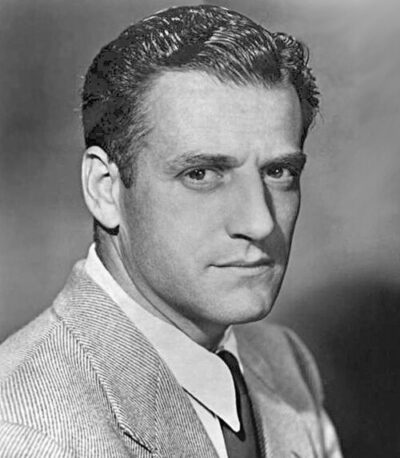
Stanley Kramer
Stanley Kramer was an American film director and producer. Born September 29, 1913, in Brooklyn. Died February 19, 2001, in Woodland Hills. Educated at New York University and Stern School of Business. Awards include Golden Globe Award for Best Director, Golden Globe Award for Best Motion Picture – Musical or Comedy and Irving G. Thalberg Memorial Award.
Facts
21 facts · 2 confirmed by two sources · 3 cited · 16 from one source
Where this comes from
Papalocal keeps its own record. It started from these sources; what each one said is kept here as it was copied, so a change on their side never changes this page by itself. Tap one to read its version.
What Wikipedia says · copied November 13, 2026 · revision 1378377365
Stanley Earl Kramer (September 29, 1913 – February 19, 2001) was an American film director and producer, responsible for making many of Hollywood's most famous "message films" (he called his movies heavy dramas) and a liberal movie icon. As an independent producer and director, he brought attention to topical social issues that most studios avoided. Among the subjects covered in his films were racism (in The Defiant Ones and Guess Who's Coming to Dinner), nuclear war (in On the Beach), greed (in It's a Mad, Mad, Mad, Mad World), creationism vs. evolution (in Inherit the Wind), and the causes and effects of fascism (in Judgment at Nuremberg). His other films included High Noon (1952, as producer), The Caine Mutiny (1954, as producer), and Ship of Fools (1965).
Director Steven Spielberg described him as an "incredibly talented visionary" and "one of our great filmmakers, not just for the art and passion he put on screen, but for the impact he has made on the conscience of the world." Kramer was recognized for his fierce independence as a producer-director, with author Victor Navasky writing that "among the independents...none seemed more vocal, more liberal, more pugnacious than young Stanley Kramer." His friend Kevin Spacey honored him in his acceptance speech for the 2015 Golden Globe for Best Actor in a TV Drama, calling him "one of the great filmmakers of all time."
Despite uneven critical reception, both then and now, Kramer's body of work has received many awards, including 16 Academy Awards and 80 nominations, and he was nominated nine times as either producer or director. In 1961, he received the Irving G. Thalberg Memorial Award. In 1963, he was a member of the jury at the 3rd Moscow International Film Festival. In 1998, he was awarded the first NAACP Vanguard Award in recognition of "the strong social themes that ran through his body of work". In 2002, the Stanley Kramer Award was created, to be awarded to recipients whose work "dramatically illustrates provocative social issues".
- Born, in its opening lines
- September 29, 1913
- Died, in its opening lines
- February 19, 2001
From the Wikipedia article “Stanley Kramer” (en.wikipedia.org/wiki/Stanley_Kramer), by its contributors, under CC BY-SA 4.0 (creativecommons.org/licenses/by-sa/4.0/). Copied November 13, 2026; not changed.
What Wikidata says · copied November 14, 2026 · revision 2569092236
- Described as
- American film director and producer (1913-2001)
- Other names
- Stanley Earl Kramer
- Born
- September 29, 1913 · 9 references
- Died
- February 19, 2001 · 9 references
- Born in
- Brooklyn
- Died in
- Woodland Hills · 1 reference
- Cause of death
- pneumonia
- Name at birth
- Stanley Earl Kramer
- Citizen of
- United States
- Occupation
- film producer · 3 references; film director · 2 references; autobiographer
- Education
- New York University; Stern School of Business; DeWitt Clinton High School · 2 references
- Awards
- Golden Globe Award for Best Director (1962); Golden Globe Award for Best Motion Picture – Musical or Comedy (1970); Irving G. Thalberg Memorial Award (1962); star on Hollywood Walk of Fame · 1 reference
- Spouse
- Marilyn Erskine (1945); Karen Sharpe (1966–2001)
- Children
- Kat Kramer; Casey Kramer
- Wikipedias with a page
- 48
Wikidata item Q73136 (wikidata.org/wiki/Q73136), public domain (CC0). Copied November 14, 2026.
Confirmed Two sources agree. Cited One source, and it names where it got it. One source One source, without a reference of its own. Sources disagree The sources disagree. We show the best-supported value and keep theirs below.
