
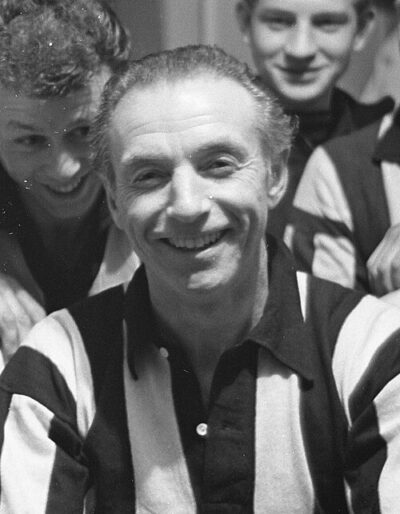
Stanley Matthews
Stanley Matthews was an English association football player. Born February 1, 1915, in Hanley. Died February 23, 2000, in Newcastle-under-Lyme. Teams include Blackpool F.C. (1947–1961), Stoke City F.C. (2 times) (1932–1965) and The Football League XI (1934–1956). Awards include Commander of the Order of the British Empire, Ballon d'Or and Ontario Sports Hall of Fame.
Facts
22 facts · 2 confirmed by two sources · 1 cited · 19 from one source
Where this comes from
Papalocal keeps its own record. It started from these sources; what each one said is kept here as it was copied, so a change on their side never changes this page by itself. Tap one to read its version.
What Wikidata says · copied November 16, 2026 · revision 2558243828
- Described as
- English association football player (1915-2000)
- Other names
- Sir Stanley Matthews
- Born
- February 1, 1915 · 6 references
- Died
- February 23, 2000 · 4 references
- Born in
- Hanley
- Died in
- Newcastle-under-Lyme
- Cause of death
- disease
- Citizen of
- United Kingdom
- Occupation
- association football player; autobiographer; association football coach · 1 reference
- Teams
- Blackpool F.C. (1947–1961); Stoke City F.C. (2 times) (1932–1965); The Football League XI (1934–1956); England men's national association football team (1934–1957); United Kingdom national association football team (1947–1955)
- Sport
- association football
- Awards
- Commander of the Order of the British Empire; Ballon d'Or; Ontario Sports Hall of Fame; Knight Bachelor
- Children
- Stanley Matthews
- Military branch
- Royal Air Force
- Height
- 1.74 m (5 ft 9 in)
- Wikipedias with a page
- 58
Wikidata item Q216140 (wikidata.org/wiki/Q216140), public domain (CC0). Copied November 16, 2026.
What Wikipedia says · copied November 16, 2026 · revision 1385657656
Sir Stanley Matthews (1 February 1915 – 23 February 2000) was an English footballer who played as an outside right. Often regarded as one of the greatest English players, he is the only player to have been knighted while still playing football, as well as being the first winner of both the European Footballer of the Year and the Football Writers' Association Footballer of the Year awards. His nicknames included "The Wizard of Dribble" and "The Magician".
Matthews kept fit enough to play at the top level until he was 50. He was also the oldest player to play in England's top football division (50 years and 5 days) and the oldest to represent the country (42 years and 104 days). He was an inaugural inductee to the English Football Hall of Fame in 2002 to honour his contribution to the English game.
Matthews spent 19 years with Stoke City, playing for the Potters from 1932 to 1947 and again from 1961 to 1965. He helped Stoke to the Second Division title in 1932–33 and 1962–63. Between his two spells at Stoke, he spent 14 years with Blackpool, where, after being on the losing side in the 1948 and 1951 FA Cup finals, he helped Blackpool to win the cup with a formidable personal performance in the "Matthews final" of 1953. In 1956, he was named the winner of the inaugural Ballon d'Or, a prize given to the best European footballer each year. Between 1934 and 1957, he won 54 caps for England, playing in the FIFA World Cup in 1950 and 1954, and winning nine British Home Championship titles.
Following an unsuccessful stint as Port Vale's general manager between 1965 and 1968, he travelled around the world, coaching enthusiastic amateurs. His experiences included coaching in South Africa, where, despite the harsh apartheid laws of the time, he established an all-black team in 1975 in Soweto known as "Stan's Men".
Including wartime results and appearances in reserve teams, he made over 1,150 appearances in his career.
- Born, in its opening lines
- February 1, 1915
- Died, in its opening lines
- February 23, 2000
From the Wikipedia article “Stanley Matthews” (en.wikipedia.org/wiki/Stanley_Matthews), by its contributors, under CC BY-SA 4.0 (creativecommons.org/licenses/by-sa/4.0/). Copied November 16, 2026; not changed.
Confirmed Two sources agree. Cited One source, and it names where it got it. One source One source, without a reference of its own. Sources disagree The sources disagree. We show the best-supported value and keep theirs below.
