
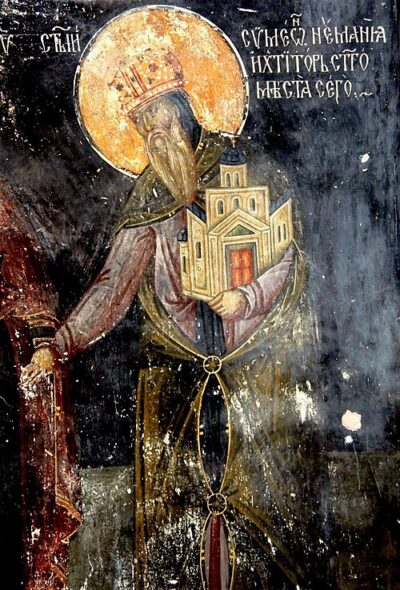
Stefan Nemanja
Stefan Nemanja was a Grand Prince of Serbia, founder of the Nemanjić dynasty. Born 1113, in Depedogen. Died February 13, 1199, in Hilandar. Positions held include župan.
Facts
19 facts · 0 confirmed by two sources · 1 cited · 17 from one source · 1 where the sources disagree
What’s different
- Born: we show 1113 (Sources disagree). Wikidata also lists 1114
Where this comes from
Papalocal keeps its own record. It started from these sources; what each one said is kept here as it was copied, so a change on their side never changes this page by itself. Tap one to read its version.
What Wikidata says · copied November 16, 2026 · revision 2550168243
- Described as
- Grand Prince of Serbia, founder of the Nemanjić dynasty
- Other names
- Stephen Nemanja
- Born
- 1113 · 1 reference; 1114 · 1 reference
- Died
- February 13, 1199
- Born in
- Depedogen
- Died in
- Hilandar
- Buried in
- Studenica monastery
- Occupation
- ruler (1166–1196); military leader; Eastern Orthodox monk (1196–1199)
- Positions held
- župan
- Spouse
- Anastasia of Serbia
- Children
- Saint Sava; Vukan Nemanjić of Serbia; Stefan the First-Crowned · 1 reference
- Father
- Zavida
- Siblings
- Tihomir of Serbia; Stracimir Zavidović; Miroslav of Hum
- Religion
- Eastern Orthodoxy (1143); Serbian Orthodox Church
- Wikipedias with a page
- 40
Wikidata item Q298612 (wikidata.org/wiki/Q298612), public domain (CC0). Copied November 16, 2026.
What Wikipedia says · copied November 16, 2026 · revision 1383947610
Stefan Nemanja (Serbian Cyrillic: Стефан Немања, pronounced [stêfaːn ně̞maɲa]; c. 1113 or 1114 – 13 February 1199) was the Grand Prince (Veliki Župan) of the Serbian Grand Principality (also known as Raška, lat. Rascia) from 1166 to 1196. A member of the Vukanović dynasty, Nemanja founded the Nemanjić dynasty, and is remembered for his contributions to Serbian culture and history, founding what would evolve into the Serbian Empire, as well as the national church. According to the Serbian Academy of Sciences and Arts, Nemanja is also among the most remarkable Serbs for his literary contributions and altruistic attributes.
In 1196, after three decades of warfare and negotiations, including the Third Norman invasion of the Balkans (1185–1186) which consolidated Serbia while distinguishing it from both Western and Byzantine spheres of influence, Nemanja abdicated in favour of his middle son Stefan Nemanjić, who later became the first King of Serbia. Nemanja ultimately went to Mount Athos, where he became a monk and took the name of Simeon, joining his youngest son (later known as Saint Sava), who had already become the first archbishop of the Serbian Orthodox Church.
Together with his son Saint Sava, Nemanja restored the Hilandar Monastery at Mount Athos from 1198 to 1199, and issued the "Charter of Hilandar". The monastery thus became the center of Serbian Orthodox monasticism at Athos. Shortly after his death, the Serbian Orthodox Church canonized Stefan Nemanja, under the name Saint Simeon the Myroblyte (Serbian: Свети Симеон Мироточиви).
From the Wikipedia article “Stefan Nemanja” (en.wikipedia.org/wiki/Stefan_Nemanja), by its contributors, under CC BY-SA 4.0 (creativecommons.org/licenses/by-sa/4.0/). Copied November 16, 2026; not changed.
Confirmed Two sources agree. Cited One source, and it names where it got it. One source One source, without a reference of its own. Sources disagree The sources disagree. We show the best-supported value and keep theirs below.
