
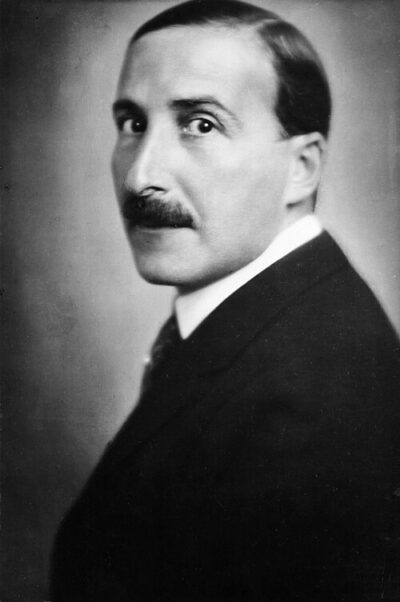
Stefan Zweig
Stefan Zweig was an Austrian writer. Born November 28, 1881, in Vienna. Died February 22, 1942, in Petrópolis. Known for The Royal Game, The World of Yesterday and Letter from an Unknown Woman. Educated at University of Vienna. Awards include Order of the Southern Cross.
Facts
30 facts · 2 confirmed by two sources · 12 cited · 16 from one source
Where this comes from
Papalocal keeps its own record. It started from these sources; what each one said is kept here as it was copied, so a change on their side never changes this page by itself. Tap one to read its version.
What Wikidata says · copied November 16, 2026 · revision 2566065692
- Described as
- Austrian writer (1881–1942)
- Other names
- S. Zweig
- Born
- November 28, 1881 · 21 references
- Died
- February 22, 1942 · 5 references
- Born in
- Vienna · 5 references
- Died in
- Petrópolis · 3 references
- Buried in
- Petrópolis Municipal Cemetery · 1 reference
- Cause of death
- barbiturate overdose
- Citizen of
- Cisleithania; Austria
- Occupation
- writer · 2 references; translator · 2 references; journalist · 1 reference; playwright; poet · 1 reference; literary critic; historian; biographer
- Education
- University of Vienna
- Known for
- The Royal Game; The World of Yesterday; Letter from an Unknown Woman; The Post Office Girl; Beware of Pity
- Awards
- Order of the Southern Cross · 1 reference
- Spouse
- Friderike Maria Zweig · 1 reference; Lotte Zweig
- Father
- Moritz Zweig · 1 reference
- Mother
- Ida Zweig · 1 reference
- Siblings
- Alfred Zweig · 1 reference
- Religion
- Judaism
- Lived in
- Salzburg · 1 reference
- Wikipedias with a page
- 127
Wikidata item Q78491 (wikidata.org/wiki/Q78491), public domain (CC0). Copied November 16, 2026.
What Wikipedia says · copied November 16, 2026 · revision 1380533920
Stefan Zweig ( ZWYGHE, SWYGHE; German: [ˈʃtɛfan t͡svaɪ̯k] or Austrian German: [t͡svaɪ̯g]; 28 November 1881 – 22 February 1942) was an Austrian writer. At the height of his literary career in the 1920s and 1930s, he was one of the most widely translated and popular writers in the world.
Born into a Jewish family, Zweig was raised in Vienna, Austria-Hungary. He wrote studies of famous literary figures, such as Honoré de Balzac, Charles Dickens, and Fyodor Dostoevsky in Drei Meister (1920; Three Masters), and of historical events in Decisive Moments in History (1927). He wrote biographies of Joseph Fouché (1929), Mary Stuart (1935) and Marie Antoinette (Marie Antoinette: The Portrait of an Average Woman, 1932), among others. Zweig's best-known fiction includes Letter from an Unknown Woman (1922), Amok (1922), Fear (1925), Confusion of Feelings (1927), Twenty-Four Hours in the Life of a Woman (1927), the psychological novel Ungeduld des Herzens (Beware of Pity, 1939), and The Royal Game (1941).
In 1934, as a result of the Nazi Party's rise in Germany and the establishment of the Ständestaat regime in Austria, Zweig emigrated to England and then, in 1940, moved briefly to New York and then to Brazil, where he settled. In his final years, he would declare himself in love with the country, writing about it in the book Brazil, Land of the Future. Nonetheless, as the years passed Zweig became increasingly disillusioned and despairing at the future of Europe, and he and his wife Lotte were found dead of a barbiturate overdose in their house in Petrópolis on 23 February 1942; they had died the previous day. His work has been the basis for several film adaptations. Zweig's memoir, Die Welt von Gestern (The World of Yesterday, 1942), is noted for its description of life during the waning years of the Austro-Hungarian Empire under Franz Joseph I and has been called the most famous book on the Habsburg Empire.
- Born, in its opening lines
- November 28, 1881
- Died, in its opening lines
- February 22, 1942
From the Wikipedia article “Stefan Zweig” (en.wikipedia.org/wiki/Stefan_Zweig), by its contributors, under CC BY-SA 4.0 (creativecommons.org/licenses/by-sa/4.0/). Copied November 16, 2026; not changed.
Confirmed Two sources agree. Cited One source, and it names where it got it. One source One source, without a reference of its own. Sources disagree The sources disagree. We show the best-supported value and keep theirs below.
