
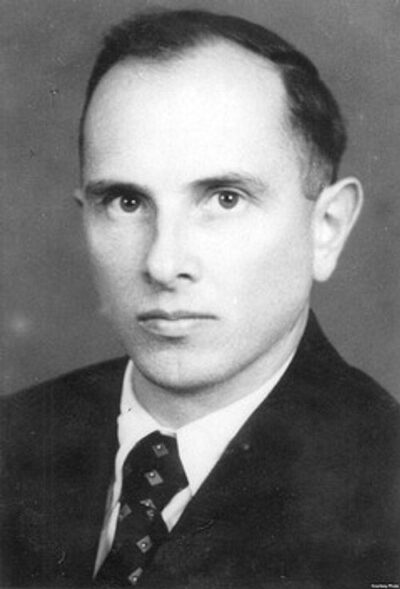
Stepan Bandera
Stepan Bandera was an Ukrainian nationalist leader. Born January 1, 1909, in Staryi Uhryniv. Died October 15, 1959, in Munich. Educated at Lviv Polytechnic. Awards include Hero of Ukraine, Order of the State.
Facts
24 facts · 2 confirmed by two sources · 6 cited · 16 from one source
Where this comes from
Papalocal keeps its own record. It started from these sources; what each one said is kept here as it was copied, so a change on their side never changes this page by itself. Tap one to read its version.
What Wikidata says · copied November 16, 2026 · revision 2567630526
- Described as
- Ukrainian nationalist leader (1909–1959)
- Other names
- Stepan Andriyovych Bandera
- Born
- January 1, 1909 · 5 references
- Died
- October 15, 1959 · 6 references
- Born in
- Staryi Uhryniv · 1 reference
- Died in
- Munich · 2 references
- Buried in
- Munich Waldfriedhof
- Cause of death
- poisoning
- Citizen of
- West Ukrainian People's Republic; Second Polish Republic · 1 reference; Austria–Hungary · 1 reference; statelessness · 1 reference
- Occupation
- politician · 1 reference
- Political party
- Organization of Ukrainian Nationalists; Organization of Ukrainian Nationalists (Banderite)
- Education
- Lviv Polytechnic
- Awards
- Hero of Ukraine, Order of the State
- Spouse
- Jarosława Bandera
- Children
- Andrii Bandera
- Father
- Andriy Bandera
- Mother
- Myroslava Bandera
- Siblings
- Vasyl Bandera · 1 reference; Oleksandr Bandera; Oksana Bandera · 1 reference; Bohdan Bandera · 1 reference
- Religion
- Ukrainian Greek Catholic Church
- Wikipedias with a page
- 79
Wikidata item Q157280 (wikidata.org/wiki/Q157280), public domain (CC0). Copied November 16, 2026.
What Wikipedia says · copied November 16, 2026 · revision 1379862212
Stepan Andriiovych Bandera (1 January 1909 – 15 October 1959) was a Ukrainian far-right leader of the radical militant faction of the Organization of Ukrainian Nationalists, the OUN-B.
Bandera was born into the family of a Ukrainian Greek Catholic priest in the Austro-Hungarian region of Galicia, which after World War I became part of Poland. Involved in nationalist organisations from a young age, he joined the Ukrainian Military Organisation in 1924. In 1931, he became head of propaganda of the Organisation of Ukrainian Nationalists (OUN), and later became head of the OUN for Poland in 1932. In 1934, he organised the assassination of the Polish interior minister, Bronisław Pieracki, for which he was sentenced to death for terrorism, subsequently commuted to life imprisonment.
During the invasion of Poland in 1939, Bandera left custody amidst the turmoil, moving on to Kraków. In 1940, the OUN split into two factions with Bandera leading the more radical faction, the OUN-B, in opposition to the OUN-M. Bandera's OUN-B was devoted to the establishment of an independent Ukrainian state, envisioned by him as "a one-party fascist dictatorship free of national minorities" according to Timothy Snyder. On 22 June 1941, the day that Nazi Germany invaded the Soviet Union, Bandera formed the Ukrainian National Committee. Its head, Yaroslav Stetsko, announced the creation of a Ukrainian state on 30 June 1941, in German-captured Lviv. The proclamation pledged to work with Nazi Germany. Germany disapproved of the proclamation and, for his refusal to rescind it, Bandera was arrested by the Gestapo and sent to the Sachsenhausen concentration camp in January 1942. The Germans released him in September 1944, in the hope that he could fight the Soviet advance. In March 1945, Bandera negotiated with the Nazis to create the Ukrainian National Army and the Ukrainian National Committee. After the war, Bandera settled with his family in West Germany, where, in 1959, he was assassinated by Bohdan Stashynsky, a KGB agent in Munich.
Bandera remains a highly controversial figure. In the post-war Soviet Union, "Banderite" became a common slur for Ukrainian nationalists. This usage persists to this day in neighbouring Russia under Vladimir Putin. On 22 January 2010, Viktor Yushchenko, the president of Ukraine, awarded Bandera the posthumous title of Hero of Ukraine, which was internationally condemned. The award was annulled in 2011 under Yushchenko's successor Yanukovych. Bandera's controversial legacy gained further prominence following the full-scale Russian invasion of Ukraine in February 2022. Opinion polling following the invasion indicated an increase in favourable views of Bandera in Ukraine.
- Born, in its opening lines
- January 1, 1909
- Died, in its opening lines
- October 15, 1959
From the Wikipedia article “Stepan Bandera” (en.wikipedia.org/wiki/Stepan_Bandera), by its contributors, under CC BY-SA 4.0 (creativecommons.org/licenses/by-sa/4.0/). Copied November 16, 2026; not changed.
Confirmed Two sources agree. Cited One source, and it names where it got it. One source One source, without a reference of its own. Sources disagree The sources disagree. We show the best-supported value and keep theirs below.
