
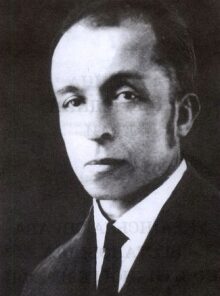
Stepan Rudnytsky
Stepan Rudnytsky was an Ukrainian geographer & ethnographer. Born December 3, 1877, in Przemyśl. Died November 3, 1937, in Sandarmokh. Educated at Lviv University.
Facts
20 facts · 2 confirmed by two sources · 3 cited · 15 from one source
Where this comes from
Papalocal keeps its own record. It started from these sources; what each one said is kept here as it was copied, so a change on their side never changes this page by itself. Tap one to read its version.
What Wikidata says · copied November 18, 2026 · revision 2561122835
- Described as
- Ukrainian geographer & ethnographer (1877-1937)
- Born
- December 3, 1877 · 1 reference
- Died
- November 3, 1937
- Born in
- Przemyśl · 2 references
- Died in
- Sandarmokh
- Buried in
- Sandarmokh
- Citizen of
- Austria–Hungary; Second Polish Republic; Czechoslovakia; Soviet Union
- Occupation
- geographer · 1 reference; ethnographer; cartographer · 1 reference
- Worked for
- Lviv University; Ukrainian Pedagogical Institute
- Education
- Lviv University
- Member of
- National Academy of Sciences of Ukraine
- Field
- geography
- Children
- Emiliia Okhrymovych-Holubovska
- Siblings
- Sofia Dnistrianska; Yuliian Opilskyi
- Wikipedias with a page
- 22
Wikidata item Q4399551 (wikidata.org/wiki/Q4399551), public domain (CC0). Copied November 18, 2026.
What Wikipedia says · copied November 18, 2026 · revision 1367542153
Stepan Rudnytsky (Ukrainian: Степан Рудницький; 3 December 1877 - 3 November 1937) was a Ukrainian geographer, professor in the Kharkiv Institute of People's Education, and director of the Ukrainian Scientific Research Institute of Geography and Cartography. He is notable for his work in defining the geology of Ukraine.
- Born, in its opening lines
- December 3, 1877
- Died, in its opening lines
- November 3, 1937
From the Wikipedia article “Stepan Rudnytsky” (en.wikipedia.org/wiki/Stepan_Rudnytsky), by its contributors, under CC BY-SA 4.0 (creativecommons.org/licenses/by-sa/4.0/). Copied November 18, 2026; not changed.
Confirmed Two sources agree. Cited One source, and it names where it got it. One source One source, without a reference of its own. Sources disagree The sources disagree. We show the best-supported value and keep theirs below.
