
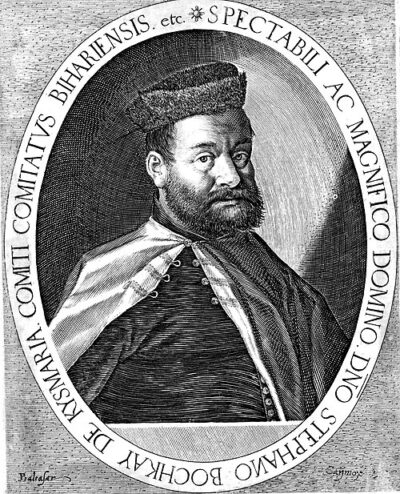
Stephen Bocskai
Stephen Bocskai was a Prince of Transylvania. Born January 1, 1557, in Cluj-Napoca. Died December 29, 1606, in Košice. Positions held include Prince of Transylvania (1605–1606).
Facts
12 facts · 2 confirmed by two sources · 4 cited · 6 from one source
Where this comes from
Papalocal keeps its own record. It started from these sources; what each one said is kept here as it was copied, so a change on their side never changes this page by itself. Tap one to read its version.
What Wikidata says · copied November 16, 2026 · revision 2568731628
- Described as
- Prince of Transylvania (1557–1606)
- Other names
- István Bocskai de Kismarja, Istvan Bocskai de Kismarja, kismarjai Bocskai István, kismarjai Bocskai Istvan, Stephen Bocskay
- Born
- January 1, 1557 · 1 reference
- Died
- December 29, 1606 · 4 references
- Born in
- Cluj-Napoca · 1 reference
- Died in
- Košice
- Buried in
- Alba Iulia · 1 reference
- Citizen of
- Principality of Transylvania
- Occupation
- military leader; politician
- Positions held
- Prince of Transylvania (1605–1606) · 1 reference
- Spouse
- Kata Hagymássy
- Father
- György Bocskai de Kismárja · 1 reference
- Mother
- Krisztina Sulyok de Leckcse · 1 reference
- Wikipedias with a page
- 36
Wikidata item Q316530 (wikidata.org/wiki/Q316530), public domain (CC0). Copied November 16, 2026.
What Wikipedia says · copied November 16, 2026 · revision 1346032946
Stephen Bocskai or Bocskay (Hungarian: Bocskai István, Slovak: Štefan Bočkaj; 1 January 1557 – 29 December 1606) was Prince of Transylvania and Hungary from 1605 to 1606. He was born to a Hungarian noble family. His father's estates were located in the eastern regions of the medieval Kingdom of Hungary, which developed into the Principality of Transylvania in the 1570s. He spent his youth in the court of the Holy Roman Emperor, Maximilian, who was also the ruler of Royal Hungary (the western and northern regions of the medieval kingdom).
Bocskai's career started when his underage nephew, Sigismund Báthory, became the ruler of Transylvania in 1581. After the Diet of Transylvania declared Sigismund of age in 1588, Bocskai was one of the few members of Sigismund's council who supported his plan to join an anti-Ottoman coalition. Sigismund made Bocskai captain of Várad (now Oradea in Romania) in 1592. After the pro-Ottoman noblemen forced Sigismund to renounce his throne in 1594, Bocskai supported him in his bid to regain it, for which Sigismund rewarded him with estates confiscated from the leaders of the opposition. On Sigismund's behalf Bocskai signed a treaty concerning the membership of Transylvania in the Holy League in Prague on 28 January 1595. He led the Transylvanian army to Wallachia, which had been occupied by the Ottomans. The Christian troops liberated Wallachia and defeated the retreating Ottoman army in the Battle of Giurgiu on 29 September 1595.
After a series of Ottoman victories, Sigismund abdicated in early 1598. The commissioners of Maximilian II's successor, Rudolph, took possession of Transylvania and dismissed Bocskai. Bocskai then persuaded Sigismund to return, but Sigismund once again abdicated in March 1599. The new prince, Andrew Báthory, confiscated Bocskai's estates in Transylvania proper. Andrew Báthory was dethroned by Michael the Brave of Wallachia. During the following period of anarchy, Bocskai was forced to stay in Prague for several months because Rudolph's officials did not trust him. After his secret correspondence with the Grand Vizier, Lala Mehmed Pasha, was captured in October 1605, Bocskai openly rebelled against Rudolph.
Bocskai hired Hajdús (irregular soldiers) and defeated Rudolph's military commanders. He expanded his authority over the Partium, Transylvania proper, and nearby counties with the support of the local noblemen and burghers who had also been stirred up by Rudolph's tyrannical acts. Bocskai was elected prince of Transylvania on 21 February 1605, and prince of Hungary on 20 April. The Ottomans supported him, but his partisans thought that the Ottomans' intervention threatened the independence of Royal Hungary. To put an end to the civil war, Bocskai and Rudolph's representatives signed the Treaty of Vienna on 23 June 1606. Rudolph acknowledged Bocskai's hereditary right to rule the Principality of Transylvania and four counties in Royal Hungary. The treaty also confirmed the Protestant noblemen and burghers' right to freely practise their religion. In his last will, Bocskai emphasized that only the existence of the Principality of Transylvania could secure the special status of Royal Hungary within the Habsburg monarchy.
- Born, in its opening lines
- January 1, 1557
- Died, in its opening lines
- December 29, 1606
From the Wikipedia article “Stephen Bocskai” (en.wikipedia.org/wiki/Stephen_Bocskai), by its contributors, under CC BY-SA 4.0 (creativecommons.org/licenses/by-sa/4.0/). Copied November 16, 2026; not changed.
Confirmed Two sources agree. Cited One source, and it names where it got it. One source One source, without a reference of its own. Sources disagree The sources disagree. We show the best-supported value and keep theirs below.
