
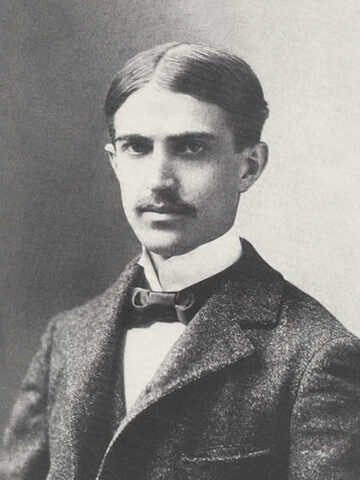
Stephen Crane
Stephen Crane was an American novelist, short story writer, poet, and journalist. Born November 1, 1871, in Newark. Died June 5, 1900, in Badenweiler. Known for The Red Badge of Courage. Teams include Syracuse Orange baseball. Educated at Syracuse University and Claverack College. Awards include New Jersey Hall of Fame.
Facts
24 facts · 2 confirmed by two sources · 7 cited · 15 from one source
Where this comes from
Papalocal keeps its own record. It started from these sources; what each one said is kept here as it was copied, so a change on their side never changes this page by itself. Tap one to read its version.
What Wikidata says · copied November 13, 2026 · revision 2565594111
- Described as
- American novelist, short story writer, poet, and journalist
- Other names
- Johnston Smith
- Born
- November 1, 1871 · 14 references
- Died
- June 5, 1900 · 15 references
- Born in
- Newark · 1 reference
- Died in
- Badenweiler · 2 references
- Buried in
- Evergreen Cemetery
- Cause of death
- tuberculosis
- Citizen of
- United States
- Occupation
- writer · 3 references; journalist · 1 reference; poet · 1 reference; baseball player; novelist; screenwriter
- Education
- Syracuse University; Claverack College; The Pennington School · 1 reference
- Teams
- Syracuse Orange baseball · 1 reference
- Sport
- baseball
- Known for
- The Red Badge of Courage
- Awards
- New Jersey Hall of Fame (2019) · 1 reference
- Father
- Jonathan Townley Crane
- Mother
- Mary Helen Peck Crane
- Religion
- atheism
- Lived in
- Arburtus Cottage (1883–1892) · 1 reference
- Wikipedias with a page
- 64
Wikidata item Q206534 (wikidata.org/wiki/Q206534), public domain (CC0). Copied November 13, 2026.
What Wikipedia says · copied November 13, 2026 · revision 1383164508
Stephen Crane (November 1, 1871 – June 5, 1900) was an American poet, novelist, and short story writer. Prolific throughout his short life, he wrote notable works in the Realist tradition as well as early examples of American Naturalism and Impressionism. He is recognized by modern critics as one of the most innovative writers of his generation.
The ninth surviving child of Methodist parents, Crane began writing at the age of four and had several articles published by 16. Having little interest in university studies though he was active in a fraternity, he left Syracuse University in 1891 to work as a reporter and writer. Crane's first novel was the 1893 Bowery tale Maggie: A Girl of the Streets, generally considered by critics to be the first work of American literary Naturalism. He won international acclaim for his Civil War novel The Red Badge of Courage (1895), considered a masterpiece by critics and writers.
In 1896, Crane endured a highly publicized scandal after appearing as a witness in the trial of a suspected prostitute, an acquaintance named Dora Clark. Late that year, he accepted an offer to travel to Cuba as a war correspondent. As he waited in Jacksonville, Florida, for passage, he met Cora Taylor, with whom he began a lasting relationship. En route to Cuba, Crane's vessel, the SS Commodore, sank off the coast of Florida, leaving him adrift for 30 hours in a dinghy. Crane described the ordeal in "The Open Boat". During the final years of his life, he covered conflicts in Greece (accompanied by Cora, recognized as the first woman war correspondent) and later lived in England with her. He was befriended by writers such as Joseph Conrad and H. G. Wells. Plagued by financial difficulties and ill health, Crane died of tuberculosis in a Black Forest sanatorium in Germany at the age of 28.
At the time of his death, Crane was considered an important figure in American literature. After he was nearly forgotten for two decades, critics revived interest in his life and work. Crane's writing is characterized by vivid intensity, distinctive dialects, and irony. Common themes involve fear, spiritual crises and social isolation. Although recognized primarily for The Red Badge of Courage, which has become an American classic, Crane is also known for his poetry, journalism, and short stories such as "The Open Boat", "The Blue Hotel", "The Bride Comes to Yellow Sky", and The Monster. His writing made a deep impression on 20th-century writers, most prominent among them Ernest Hemingway, and is thought to have inspired the Modernists and the Imagists.
- Born, in its opening lines
- November 1, 1871
- Died, in its opening lines
- June 5, 1900
From the Wikipedia article “Stephen Crane” (en.wikipedia.org/wiki/Stephen_Crane), by its contributors, under CC BY-SA 4.0 (creativecommons.org/licenses/by-sa/4.0/). Copied November 13, 2026; not changed.
Confirmed Two sources agree. Cited One source, and it names where it got it. One source One source, without a reference of its own. Sources disagree The sources disagree. We show the best-supported value and keep theirs below.
