
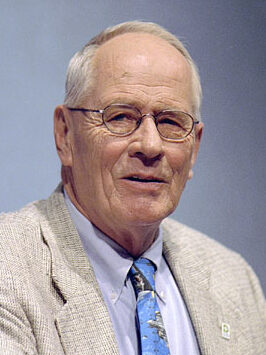
Stephen E. Ambrose
Stephen E. Ambrose was an American historian and writer. Born January 10, 1936, in Decatur. Died October 13, 2002, in Bay St. Louis. Teams include Wisconsin Badgers football. Educated at University of Wisconsin–Madison and Louisiana State University. Awards include National Humanities Medal and St. Louis Literary Award.
Facts
30 facts · 2 confirmed by two sources · 9 cited · 19 from one source
Where this comes from
Papalocal keeps its own record. It started from these sources; what each one said is kept here as it was copied, so a change on their side never changes this page by itself. Tap one to read its version.
What Wikidata says · copied November 15, 2026 · revision 2567619784
- Described as
- American historian and writer (1936–2002)
- Other names
- Stephen Edward Ambrose
- Born
- January 10, 1936 · 6 references
- Died
- October 13, 2002 · 7 references
- Born in
- Decatur
- Died in
- Bay St. Louis · 1 reference
- Cause of death
- lung cancer
- Citizen of
- United States · 2 references
- Occupation
- historian · 1 reference; essayist · 2 references; university teacher; biographer · 1 reference; writer · 1 reference
- Worked for
- Johns Hopkins University; LSU New Orleans; Kansas State University; Naval War College · 1 reference
- Education
- University of Wisconsin–Madison; Louisiana State University; Whitewater High School · 1 reference
- Teams
- Wisconsin Badgers football
- Awards
- National Humanities Medal (1998) · 1 reference; St. Louis Literary Award (1997)
- Field
- history of the United States · 1 reference; history · 1 reference; military history · 1 reference; history of war · 1 reference; biography · 1 reference
- Children
- Hugh Ambrose · 1 reference
- Religion
- Congregational churches
- Lived in
- Decatur; Helena
- Wikipedias with a page
- 31
Wikidata item Q443953 (wikidata.org/wiki/Q443953), public domain (CC0). Copied November 15, 2026.
What Wikipedia says · copied November 15, 2026 · revision 1382188565
Stephen Edward Ambrose (January 10, 1936 – October 13, 2002) was an American historian and author whose work focused particularly on World War II, the American West, and the lives of U.S. presidents Dwight D. Eisenhower and Richard Nixon. He taught history from 1960 until his retirement in 1995 and was a member of the University of New Orleans faculty from 1971, becoming Boyd Professor of History in 1989. He also founded the university's Eisenhower Center and co-founded the National D-Day Museum, later designated the National World War II Museum.
Ambrose's books included The Supreme Commander and a two-volume biography of Eisenhower, a three-volume biography of Nixon, Band of Brothers (1992), D-Day (1994), Undaunted Courage (1996), Citizen Soldiers (1997), Nothing Like It in the World (2000), and The Wild Blue (2001). D-Day became his first bestseller, while Citizen Soldiers and Undaunted Courage also appeared on The New York Times best-seller lists. He received the National Humanities Medal and the Samuel Eliot Morison Prize in 1998, among other awards.
Ambrose's work was also the subject of controversies over plagiarism and historical accuracy. Several of his books were found to contain plagiarized passages, with a Forbes investigation tracing the pattern back to his doctoral dissertation. After his death, presidential library records contradicted his claims of having conducted hundreds of hours of interviews with Eisenhower, showing that the two had met only three times for fewer than five hours in total; this led several historians to conclude that Ambrose had fabricated interviews and exaggerated his access.
- Born, in its opening lines
- January 10, 1936
- Died, in its opening lines
- October 13, 2002
From the Wikipedia article “Stephen E. Ambrose” (en.wikipedia.org/wiki/Stephen_E._Ambrose), by its contributors, under CC BY-SA 4.0 (creativecommons.org/licenses/by-sa/4.0/). Copied November 15, 2026; not changed.
Confirmed Two sources agree. Cited One source, and it names where it got it. One source One source, without a reference of its own. Sources disagree The sources disagree. We show the best-supported value and keep theirs below.
